What Sets a Diamond Price? Carat, Cut, Colour, Clarity
Diamond price depends on carat, cut, colour, clarity and the certificate, not a single number. See what actually moves it before you design a ring.
A diamond price is not one figure — it moves with carat weight, cut quality, colour, clarity, whether the stone is natural or lab-grown, and what its certificate confirms. Two stones that look alike side by side can carry very different prices once those factors are compared properly. This guide explains what actually drives the number, so a conversation about a specific ring starts from the right questions.
What are the four factors that set a diamond’s price?
Jewellers call them the four Cs, and each pulls the price in its own direction.
- Carat is the stone’s weight, not its size on the finger — two diamonds of the same carat can look different depending on cut. Price rises with carat, and it rises faster past certain weights, because larger rough stones are rarer.
- Cut describes how well a stone’s proportions and facets return light, graded independently of shape. A well-cut stone can look larger and brighter than a heavier one cut poorly, and cut grade is one of the biggest swings in price for a given carat. Our guide to diamond cut covers how the grade is worked out.
- Colour is graded on a scale from colourless down, and the closer to colourless, the higher the price, because colour is more visible in larger stones and step-cut shapes like emerald or asscher.
- Clarity measures inclusions and blemishes inside the stone. Higher clarity costs more, but many inclusions are invisible to the naked eye at normal viewing distance, which is where a jeweller’s judgement matters more than the grade alone — our diamond clarity guide explains what actually shows.
Does natural or lab-grown change the price?
Yes, meaningfully. A lab-grown diamond is chemically and optically identical to a natural one, but it typically costs less for the same carat, cut, colour and clarity, because it is grown rather than mined. Neither is the “correct” choice — the difference is origin and budget, not quality, and CIZELE shows the same design in both so the comparison is direct rather than a sales pitch. Our piece on lab-grown diamonds in Egypt goes into how that shift has played out locally.
Does diamond shape affect price?
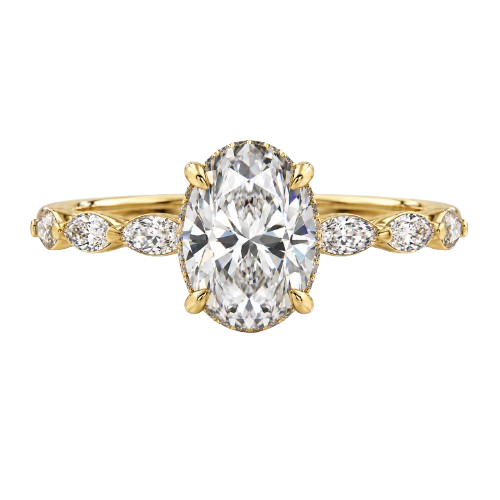
Yes. A round diamond uses the most rough stone in cutting, which is part of why it usually costs more per carat than a fancy shape of the same weight and grade. Elongated shapes such as oval, pear and marquise can look larger for their carat weight, which is one reason some buyers choose them on a fixed budget. Our guide to diamond shapes sets out how each of the ten shapes CIZELE works with compares, on top of the cut, colour and clarity differences above.
Does the certificate matter to the price?
It matters to what the price is actually paying for. A certificate from GIA or IGI states carat, cut, colour and clarity independently of the seller, so the price can be checked against an objective grade rather than a description. Two stones priced the same without certification are not necessarily equal; our guide to reading a GIA, HRD or IGI certificate explains what each line means, and the standards themselves are published by GIA.
Why doesn’t this article state a figure?
Because a single number would be misleading. Every one of the factors above moves the price independently, and a stone that suits one design does not suit another. The only honest way to see what a specific ring would cost is to look at CIZELE’s live diamond inventory, where certified stones are listed individually with their own grading, or to start designing on /create/ and have the cost worked out against an actual stone, setting and metal.
How much should you budget before a consultation?
Budget is a starting point, not a fixed price, and it depends on the same four Cs plus setting and metal. Readers weighing this up before a first conversation may find how much to actually spend on an engagement ring in Egypt useful, alongside where to buy an engagement ring in Egypt for how the wider market compares.
What is a fair diamond price for a ring in Egypt?
There is no single fair diamond price, because “fair” only means something once carat, cut, colour, clarity, origin and certification are all matched against the same stone. Two rings can look similar in photographs and sit at very different prices once those factors are compared side by side, which is why comparing listings by carat alone is misleading. The only reliable comparison is stone against stone, on the same grading scale, ideally both certified by the same laboratory.
How CIZELE prices a ring
CIZELE builds every ring to order once a stone, shape, setting and metal are chosen together, generally in about two to six weeks from consultation to finished piece. Because the diamond is the largest single cost in most rings, the fastest way to a real number is to look at live inventory, describe a design on /create/, or message CIZELE directly on WhatsApp and book a private video consultation to price a specific stone rather than guess at an average.