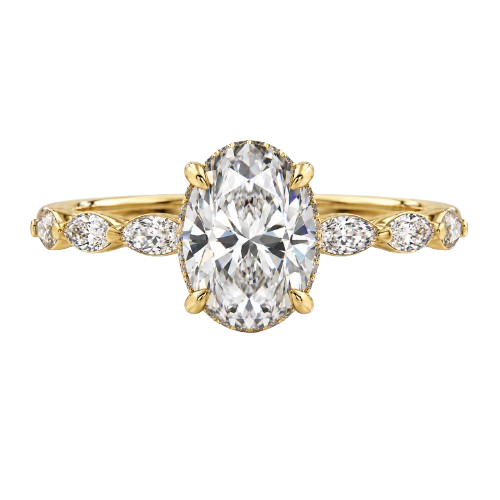

Ring Resizing: What Can Change and What Can’t
Ring resizing changes a band's size, but not every ring can move far. See what actually limits it, and how CIZELE handles resizing, free for life.
Ring resizing changes the circumference of a band, usually by cutting it, adding or removing a small section of metal, and rejoining it, a process most rings can go through more than once over a lifetime. What limits resizing is not the metal but the setting: a plain or lightly set band moves easily, while a ring covered edge to edge in diamonds has far less room to work with. Knowing the difference before choosing a design avoids a limit being discovered only when a size actually needs to change.
How does ring resizing actually work?
A jeweller cuts the band at one point, then either removes a section and rejoins it to make the ring smaller, or adds a section of matching metal to make it larger. The join is smoothed and polished until it is invisible, and the ring is checked for roundness and stone security afterwards. Going up in size is usually easier than going down, because adding metal is more straightforward than removing it cleanly from a shaped band.
What can be resized easily?
- Plain bands. A plain band with no stones, or stones only near the top, has metal on the sides free to cut and rejoin without disturbing a setting.
- Solitaires. A classic solitaire with a single stone at the centre and a plain shank behind it resizes in the same way as a plain band, because the cut point sits away from the setting.
- Bezel settings. A bezel setting encloses the stone in metal rather than prongs, which protects it well during the resizing process itself.
What is difficult or impossible to resize?
- Full eternity or full pavé bands. A band set with diamonds all the way around has no plain section to cut without cutting through a stone. This is the hardest case: resizing usually means removing and resetting stones near the cut point, which adds cost and risk, or in some cases is not possible at all without remaking the section.
- Very large size changes. Moving more than two or three sizes changes the ring’s proportions, not just its circumference, and can leave a visibly thinner or thicker band on one side. Some designs, such as a shaped toi et moi or east-west setting, distort more visibly under a large resize than a simple round band does.
- Rings with accents around the band. Accent stones set partway around a band limit resizing less than a full eternity setting, but still more than a plain shank, because the cut point has to avoid them.
How many sizes is realistic in one resize?
As a rule of thumb, a jeweller can move a ring one to two sizes comfortably without changing its look or compromising the setting. Beyond that, the ring’s proportions start to shift, and a full eternity or pavé band may need stones reset rather than simply cut and rejoined. This is part of why getting an accurate size before a ring is made matters more than being able to correct it afterwards: see how to find her ring size without ruining the surprise for how to measure discreetly.
Does resizing affect the diamond or the certificate?
Resizing itself does not touch the stone if it is done carefully: the diamond is unset or protected in place while the band is cut, then reset. A GIA or IGI certificate describes the stone independently of its setting, so resizing does not change what the certificate says. It is worth having any resizing done by whoever set the stone, so the setting is checked at the same time, and any loose prongs or worn claws are caught before they become a real risk to the diamond rather than only a cosmetic one.
When should you ask about resizing before ordering?
The best time to raise ring resizing is at the design stage, not after the ring arrives. A jeweller who knows a size might change later can leave a fraction more metal at the shank, choose a setting that tolerates cutting and rejoining, or flag upfront that a chosen design, full pavé, for example, will be harder to adjust. Raising it early costs nothing and avoids a design being finished before a limitation is understood.
How CIZELE handles resizing
CIZELE will resize a ring it made, free of charge, for as long as the owner keeps it, since ring size changes over a lifetime, and that is not meant to be the client’s problem to pay for. Designs are built with this in mind from the start: a round, oval or cushion stone in a solitaire or bezel setting keeps resizing straightforward later, which is worth discussing before choosing a full pavé band if future resizing matters. To start a design, or to ask about resizing an existing piece, describe it on /create/, message CIZELE on WhatsApp, or book a private video consultation.