Lab-Grown Diamonds in Egypt: Why They Are Changing How We Buy
They are real diamonds, grown rather than mined, and they are quietly rewriting what a given budget can buy. Here is the honest picture.
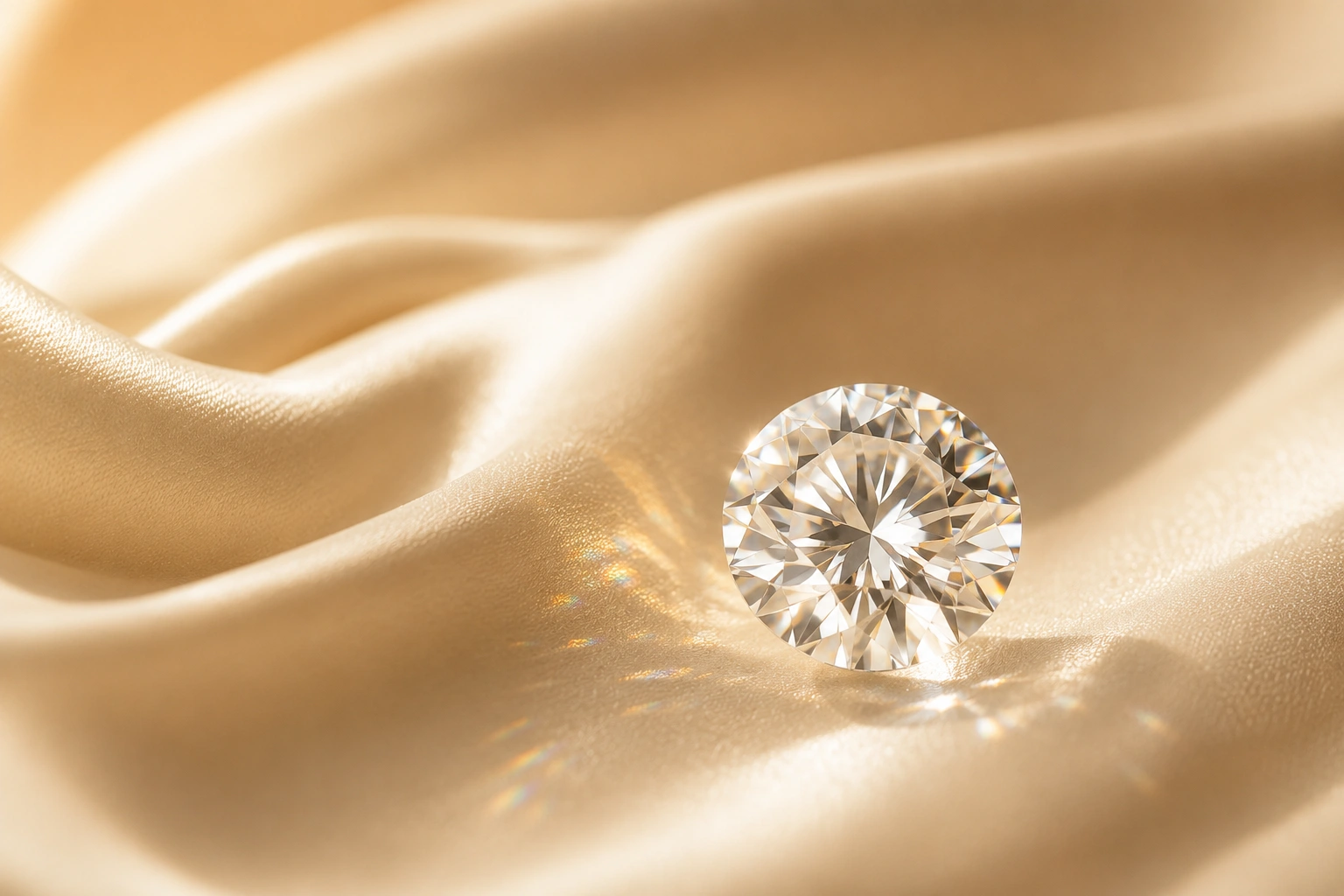
A lab-grown diamond is a real diamond. Not a simulant, not cubic zirconia, not “almost”. It has the same carbon structure, the same hardness, the same fire and brilliance as a diamond pulled from the ground. The only difference is origin: one was grown in a controlled environment over a few weeks, the other formed over a billion years and was mined. Under a loupe, even a trained jeweller cannot tell them apart, they are told apart only by specialised equipment and the certificate.
Why this matters in Egypt specifically
Internationally, lab-grown diamonds have gone from a curiosity to a mainstream choice in only a few years. In Egypt, the shift is younger, and that gap is an opportunity. Because the local market is still catching up, couples who understand lab-grown early tend to get noticeably more stone for their money, more carat, higher clarity, better colour, at a price that would buy something much smaller in a natural stone.
How they are grown
There are two genuine methods, and it is worth knowing them because a good jeweller will talk about them openly:
- HPHT (High Pressure, High Temperature) recreates the heat and pressure deep in the earth, growing a diamond around a small seed crystal.
- CVD (Chemical Vapour Deposition) grows the diamond layer by layer from a carbon-rich gas, in a vacuum chamber.
Both produce genuine diamonds. Both are graded on exactly the same four Cs, cut, colour, clarity and carat, as natural stones.
The honest trade-offs
No product is perfect, and pretending otherwise is how people get sold to. Here is the balanced view:
- For value and size: lab-grown wins clearly. Your budget simply goes further.
- For rarity and long-term resale: natural diamonds hold a scarcity value that lab-grown, by definition, does not. If a stone is partly an investment or an heirloom-as-asset, that matters.
- For ethics and traceability: lab-grown stones have a fully known origin, which some couples care about deeply.
Choose lab-grown for the size and the value. Choose natural for the rarity. Both are real, and both are a legitimate way to buy.
What to insist on
Whichever you choose, ask for certification from GIA or IGI, and ask whether the stone carries a laser inscription that matches its certificate, that is your proof the stone in the ring is the stone on the paper. A jeweller who welcomes that question is one worth buying from.
The arrival of lab-grown diamonds has not replaced natural stones, it has widened the choice. And a wider, better-understood choice is exactly what makes for a confident purchase.
Made to order · finished by hand
See our certified lab-grown and natural diamonds, filter by cut, carat and clarity.