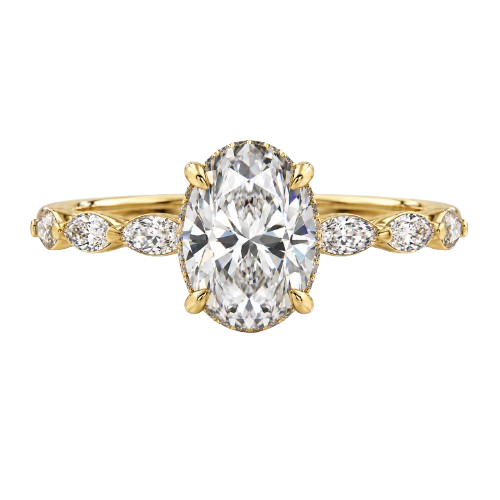

What Actually Happens in a Bespoke Consultation
No prices on a screen, no pressure, no obligation. What we ask, what you should bring, what you leave with, and what happens in the weeks after.
You do not need to arrive with a design. Most people arrive with a photograph, a vague idea, or nothing at all beyond a feeling about the person they are buying for. All three are a perfectly good starting point, and the third one is more common than you would think.
- It is a conversation, not a sales appointment. Nothing is decided on the spot.
- Bring a reference if you have one. A screenshot is genuinely useful.
- Bring an existing ring if sizing or matching matters.
- You will be asked about her life, not just her taste. It changes the design.
- You leave with a direction and a quote, not a contract.
Why there are no prices on the site
Because almost nothing here is a fixed product. A design in one cut, one carat and one metal is a different piece from the same design in another, and the stone is usually the largest part of the cost. A price list would either be wrong or so heavily caveated as to be useless.
It also means the conversation starts with what you want rather than with what you are willing to spend, which produces better rings. We will ask about budget, and we will be direct about what is realistic within it, but it is not the first question.
What we ask
The obvious things first. Who it is for, when you need it, whether it is a surprise, and whether there is a date that cannot move.
Then the less obvious ones, which matter more than people expect. What she does with her hands all day. Whether she wears jewellery constantly or takes it off. Whether she has ever mentioned a stone shape, or admired something on someone else. What she already owns, because that tells us more about her taste than any adjective will.
Someone who works with their hands, swims daily, or has small children needs a different setting from someone who does not. A stone set high catches light beautifully and catches everything else too. That is a real trade-off and it is better to make it deliberately.
Choosing the stone
Every stone we offer is certified, and we will show you the certificate rather than describe it. We work with natural and lab-grown diamonds and treat both as legitimate choices, because they are. A lab-grown diamond is chemically and optically a diamond. What it is not is rare in the same way, and that difference is reflected in what it costs.
You will see stones in person wherever possible, because a certificate describes a stone and does not tell you how it looks on a hand. Two stones with identical paperwork can look meaningfully different, and choosing between them is the part that has to be done with your eyes.
Designing it
Once the direction is agreed, the design is drawn and then modelled so you can see the piece in three dimensions before anything is made. This is where changes belong. Adjusting a band width or a prong style on a drawing costs nothing. Adjusting it after casting means starting again.
Expect to go back and forth. It is normal, it is expected, and it is the part where a design stops being a reference photograph and starts being your ring. Nothing is cast until you have approved it.
Making it
The piece is cast, the stones are set by hand, and it is polished and checked. This is the part that takes weeks rather than days, and it is not something that can be usefully rushed. Setting a stone badly to save two days is not a saving.
If you have a fixed date, say so at the very first conversation. We would rather tell you honestly at the start that a timeline is tight than discover it late.
What you are committing to
At the consultation, nothing. You leave with a direction, a realistic quote, and a clear idea of the timeline. If you want to think about it, think about it. If you want to talk to someone else first, that is a reasonable thing to do with a purchase like this.
When you do go ahead, the piece is covered by our warranty against fault in our own making, resizing is free, and cleaning and checking continue for as long as you own it.
Share your idea, a reference, or nothing at all, and a designer will reply personally within 24 hours. If you would rather explore on your own first, start with a setting or a stone and see where it takes you.