
Choosing a Wedding Band That Actually Sits With Your Engagement Ring
Why so many bands leave a gap, what a shaped or contoured band really solves, and when it is smarter to design the pair together from the start.
The gap is the problem nobody warns you about. A straight band placed against a ring with a raised centre stone will not sit flush. It rocks, it leaves a visible wedge of daylight, and over years the two rings grind against each other. All of it is solvable, and most of it is far easier to solve before either ring is made.
- A straight band suits a low or flush setting. Against a raised stone it will almost always leave a gap.
- A shaped band is cut to follow your ring’s profile, so the two meet along their whole length.
- Mixing metals is a choice, not a mistake, but mixing hardness is worth thinking about.
- Wear both on the same finger before you commit, if there is any way to try.
- Designing the pair together removes the problem entirely.
Why the gap happens
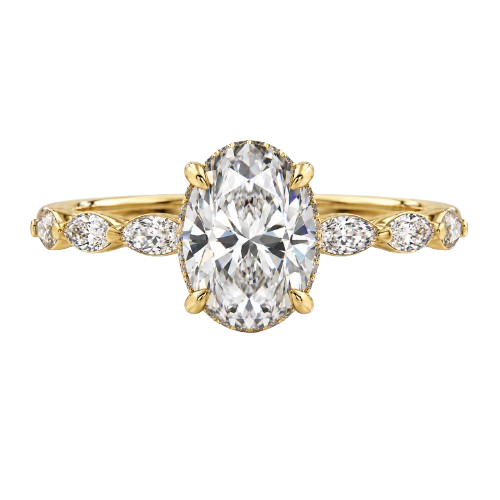
An engagement ring holds a stone above the band. The higher it sits, and the more the setting flares outward at the base, the further a straight band has to stay away. That distance is the gap.
It is not a fault. It is geometry. A solitaire with a high cathedral setting will hold a straight band at a distance, and no amount of pushing them together changes that. What changes it is shaping the band.
What a shaped band actually is
A shaped or contoured band is made with a curve, a notch or a dip cut into its profile so it nests around the engagement ring instead of butting against it. Done properly, the two look like one object rather than two rings sharing a finger.
This has to be made for the specific ring. A shaped band bought off a shelf is shaped for a ring that is not yours, and the odds of the curve matching are poor. This is the single strongest argument for having both made by the same hands.
There is a second, quieter benefit. Two rings that meet along their whole length do not rock against each other. Rocking is what wears metal away at the contact points, and it is what loosens stones set near the base of an engagement ring over a long marriage.
Matching metal, and when not to
The safe answer is to match. Yellow gold with yellow gold, white with white. The pair reads as one set and there is nothing to think about.
Mixing is a legitimate choice and it looks deliberate when it is done with conviction rather than by accident. A rose gold band against a white gold ring is a decision. A slightly different shade of yellow gold against another slightly different shade of yellow gold just looks like a mistake, because it reads as an attempt to match that failed.
The practical consideration is hardness rather than colour. Two metals of noticeably different hardness worn against each other every day will wear unevenly, with the softer one giving way. If you are mixing, mix with your eyes open about which ring will show it first.
Width, and how it changes the ring you already own
A band changes how the engagement ring reads. A wide band next to a delicate ring makes the delicate ring look smaller. A very fine band against a substantial ring can look like an afterthought.
Proportion is easier to judge in person than in a photograph, because a photograph flattens the height of the stone and the height is most of what your eye is responding to. If there is any opportunity to see the two together on your own hand, take it.
Plain, pave or accented
A plain band is the quietest option and it ages best. It does not compete, it never looks dated, and it takes the daily wear that a stone-set band would take on its stones instead.
A pave band puts a continuous line of small diamonds beside the centre stone, which is beautiful and which asks something of you in return. Small stones in a ring worn every day need checking, because a lost pave stone is a repair rather than a catastrophe but it is still a repair.
An accented band sets stones part of the way around, leaving the underside plain. It is a genuine middle ground, and it also means the part of the ring that takes the most contact against your other fingers is solid metal.
The simplest answer
If you have not bought either ring yet, design them together. The band gets shaped to the ring, the metals match by intention, the proportions are judged as a pair, and the gap never exists in the first place.
If you already have an engagement ring, bring it. A band can be shaped to almost anything once we can see and measure the ring it has to live beside.
Look at the band profiles, or bring your ring in and we will shape one to it.