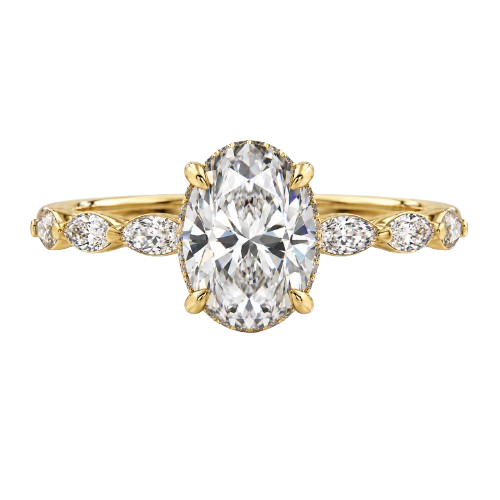

Caring for Fine Jewellery in Egypt: Heat, Sand, Salt and Sunscreen
Everything that dulls a ring here is ordinary and avoidable. What actually damages gold and diamonds in this climate, and the small habits that keep a piece looking new.
Nothing dulls a diamond faster than sunscreen. Not sand, not sea water, not heat. A film of oil across the underside of a stone blocks the light that would otherwise come back through it, and the ring looks tired within days. The good news is that everything on this list is ordinary and entirely avoidable.
- Sunscreen and hand cream are the main cause of a dull-looking diamond.
- Sand is an abrasive. Treat the beach the way you would treat sandpaper.
- Chlorine attacks alloy, not the diamond. Gold is not pure metal, and the parts that are not gold can be damaged.
- Heat loosens nothing on its own, but it swells fingers, and forcing a ring off a swollen finger bends prongs.
- A soft brush and warm soapy water solves most of it, at home, in two minutes.
The oil problem
A brilliant-cut diamond works by taking light in through the top, bouncing it around inside, and sending it back to your eye. That depends on clean facets, particularly underneath, where you never look and never think to clean.
Sunscreen, hand cream, soap residue and the natural oil from your own skin all settle there. The stone does not become damaged in any way, but it stops performing. People often assume their diamond has somehow lost its life, when it has simply been coated.
Warm water, a drop of ordinary washing-up liquid, and a soft toothbrush kept for this purpose. Brush behind and underneath the stone, not just across the top. Rinse, and dry with a lint-free cloth. Every week or two is plenty, and the difference is immediate and slightly startling the first time.
Sand, which is genuinely abrasive
Sand is largely quartz, and quartz is hard enough to scratch gold without any effort at all. A day at the North Coast or in the desert, with sand between a ring and your skin, is a day of fine polishing you did not ask for.
Diamonds themselves are safe. Nothing in ordinary life scratches a diamond. It is the metal that suffers, and the softer the metal the faster it happens. Take rings off before the beach, and if you would rather not leave them in a hotel room, wear them on a chain instead.
Salt water and chlorine
Sea water is not dramatic, but it is not neutral either. Rinse in fresh water afterwards and dry properly, particularly around the setting where water sits.
Chlorine deserves more caution. Gold jewellery is an alloy, because pure gold is far too soft to hold a stone. Chlorine can attack the other metals in that alloy over repeated exposure, and the damage shows up around the parts under the most stress, which is exactly where you least want weakness. Take rings off before a pool. It is a small habit that prevents a real problem.
Heat, and the mistake it causes
Heat does not damage gold or diamonds at any temperature you will encounter. What it does is swell your fingers, and a ring that slid off easily in March will not in August.
The damage happens in the struggle. Pulling hard at a stuck ring, twisting it, levering it against a knuckle, is how prongs get bent and how stones eventually come loose. If a ring will not come off, run your hand under cold water, raise it above your head for a minute, and use soap. Never force it.
What you cannot do at home
Cleaning is yours. Structural checks are not. Prongs wear down over years of ordinary contact, and the wear is gradual enough that you will not notice it until something moves. A jeweller can see it long before that.
Have settings checked periodically, especially on a ring worn every day, and especially on any setting where the stone sits high and takes knocks. It takes minutes, and it is the difference between tightening a prong and searching a carpet.
Ultrasonic cleaners are excellent for some pieces and a genuinely bad idea for others, particularly anything with an emerald, an opal, or a stone with visible inclusions reaching the surface. If you are not certain what you have, ask before you use one.
The habit that matters most
Take it off for the things that deserve it. Cleaning, gardening, the gym, the beach, the pool, and anything involving heavy lifting. Put it in the same place every single time, because the second largest cause of lost rings is not theft or faulty settings. It is a ring set down somewhere unfamiliar.
Every CIZELE piece is made to be worn rather than kept in a box, and aftercare, cleaning and checking are part of what we offer for as long as you have it. If something does not look right, bring it in and let us see it.
If you are still choosing, and you want a setting that suits a life with sand and sea and heat in it, tell us how you actually live and we will design around that.