
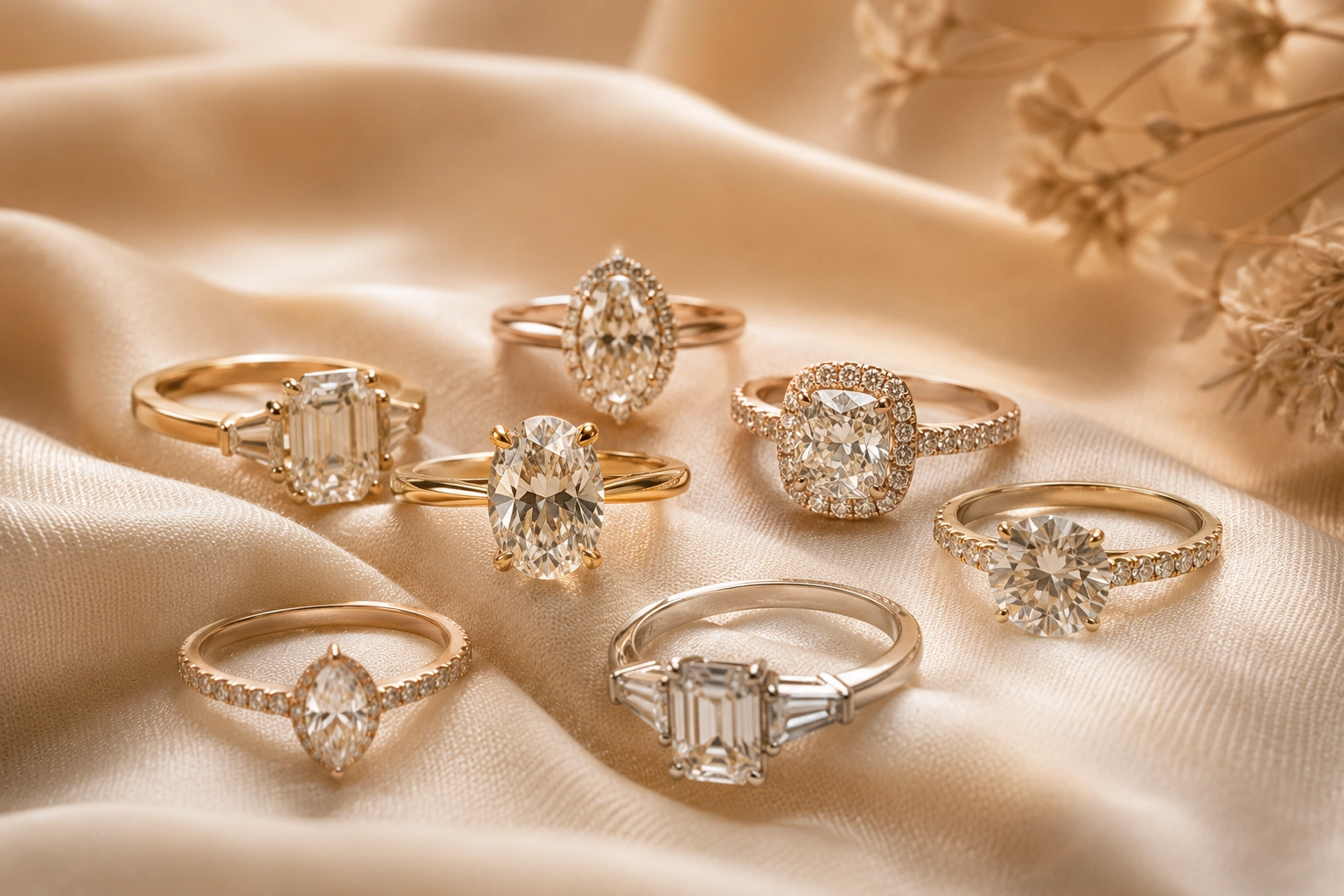
Round Cut Diamond: Why It Sparkles More Than Others
A round cut diamond returns the most light, so it reads brighter at a smaller carat. This guide covers cut grade, size and the settings that suit it.
A round cut diamond, also called a round brilliant, is built to return more light to the eye than any other shape, because its facets are arranged in a symmetrical pattern calculated specifically for maximum brilliance. That’s why round is the shape every other cut gets measured against, and why two stones of identical carat weight can look noticeably different in brightness depending on how well the round one is actually cut. This guide covers what cut grade means in practice, how a round cut diamond compares on size against elongated shapes, and which settings suit it.
Why does a round cut diamond sparkle more than other shapes?
A round brilliant has 57 or 58 facets arranged to bounce light back up through the top of the stone rather than losing it out the sides or bottom, and that geometry has been refined for over a century specifically for this shape. Oval, pear and marquise cuts are all derived from the same brilliant-cut facet logic stretched into an elongated outline, which is part of why they still sparkle well but rarely match a well-cut round stone for sheer brightness. A cushion or princess cut trades some of that brilliance for a more geometric outline. If you want to see how round compares directly against the other nine shapes CIZELE works with, our diamond shapes guide lays them out side by side. It’s also worth knowing that fluorescence, a faint glow some diamonds show under UV light, interacts with cut differently depending on shape; our guide to diamond fluorescence covers what to check for if a certificate lists it.
What does cut grade actually measure?
Cut grade measures how precisely a diamond’s facets are angled and proportioned relative to each other, not its shape, carat or clarity. A poorly cut round diamond will look duller than a well-cut one even at the same carat and colour. GIA grades cut on a scale from Excellent to Poor based on proportions, symmetry and polish, and for round diamonds specifically this grading is the most reliable because the shape has the longest-established standard to measure against, with decades more cutting data behind it than any other shape. Our guide to diamond cut breaks down what each grade band actually changes visually, and it’s worth reading before you compare certificates, since GIA’s own education pages are the independent source graders are trained against.
Two figures on the certificate are worth finding yourself rather than taking the summary grade on trust. Table percentage describes how wide the flat top facet is relative to the stone’s diameter, and depth percentage how deep the stone sits from top to bottom. A round cut too shallow lets light escape through the bottom instead of returning it, and one cut too deep sends light out of the sides, and both look darker in the centre than the carat weight would suggest. The grade band already accounts for this, so an Excellent round needs no second-guessing; the numbers matter most when you are comparing two stones that carry the same grade.
How does round compare to elongated shapes for size?
A round diamond generally looks a little smaller for its carat weight than an elongated shape like oval or marquise, because its weight is distributed evenly across a circle instead of stretched across a longer outline. A 1-carat oval, for instance, typically covers more visible surface area than a 1-carat round, and our 1-carat diamond ring guide shows how that plays out at a specific weight. What round gives up in apparent size, it tends to make back in brightness and in how evenly it wears over decades, since there are no narrow points on the outline to catch or chip. If apparent size is the priority, our 2-carat diamond ring guide is worth reading alongside this one, since the gap between round and an elongated shape widens as carat weight increases.
Which settings suit a round diamond best?
A round diamond suits almost every setting CIZELE makes, which is part of why it’s the shape most people start with. A solitaire keeps the attention entirely on the stone’s brilliance with nothing competing for the eye, which is why it’s often the first setting people consider for a round stone. A halo of smaller diamonds around a round centre stone adds even more sparkle from the sides, and a bezel setting wraps the stone’s edge in metal for a more secure, modern look that slightly tones the brilliance down. There’s a reason round carries every style of setting without looking wrong in any single one of them: see our piece on round as the shape every other cut is measured against for more on exactly why that is true.
Is a round diamond the right choice for you?
If brightness and timelessness matter more to you than looking large for the carat, round is very hard to beat. If apparent size matters more, an elongated shape is worth comparing directly before you decide. Either way, a round diamond chosen through CIZELE comes from live certified inventory, checked against GIA or IGI paperwork rather than taken on faith. Sketch what you have in mind in the ring builder, or talk it through on a private video consultation — lead time from a first conversation to a finished ring usually runs 2 to 6 weeks depending on the design. Message us on WhatsApp to get started.
