
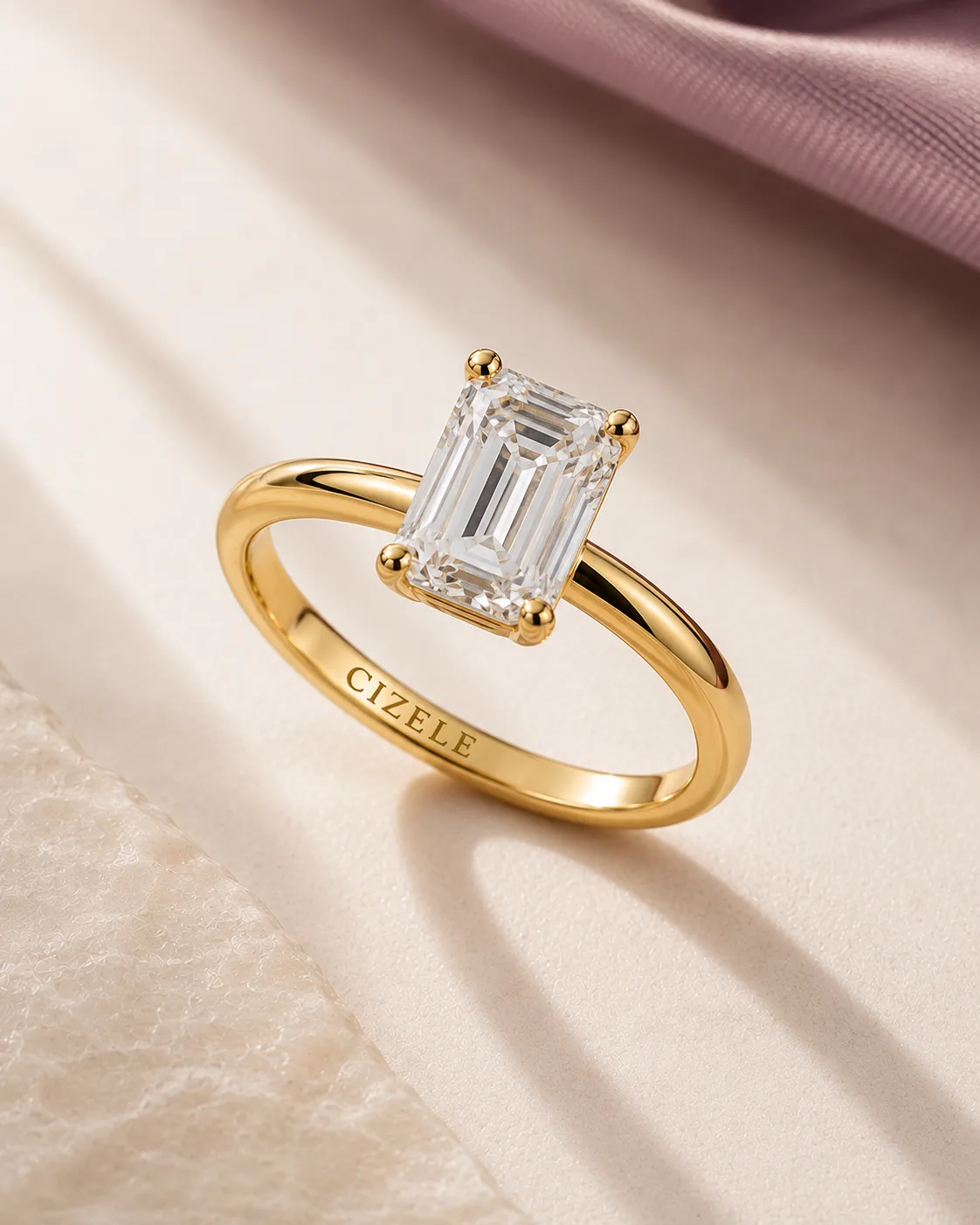
Gold Jewelry: A Buyer’s Guide to Karat and Weight
Buying gold jewelry? Here is what karat marks, weight and finish actually tell you about a ring worn every day, from CIZELE.
Buying gold jewelry comes down to three things you can check before you pay: the karat stamp, the weight for the design, and how the surface is finished. Get those three right and the piece wears the way it looks on day one for years. Get them wrong and a ring that looked identical in a photograph behaves completely differently on the hand.
What Karat Means When Buying Gold Jewelry
The karat number on a gold jewelry piece states how much of the metal is pure gold out of 24 parts. 24k is pure gold, which is too soft for daily wear and marks easily. 18k is 75% gold alloyed with metals like copper, silver or palladium for strength; 21k is about 87.5% gold, softer than 18k but closer to the deep yellow colour associated with gold in Egypt. Neither is “better” in the abstract: 18k holds a shape, a claw or a thin band more reliably over years of wear, while 21k reads richer and warmer against the skin. CIZELE’s comparison of the two sets out which suits which kind of ring. A piece should always be stamped with its karat; if it is not marked anywhere, that is itself something to ask about before buying.
The hardness difference between karats is not marketing language; it is measurable, and it is why the two are suited to different pieces. Pure gold on the Mohs scale sits around 2.5 to 3, soft enough to dent with a fingernail under enough pressure. Alloying it with copper, silver or palladium raises that hardness, and 18k, with a quarter of its content given over to those harder metals, resists scratching and bending noticeably better than 21k over years of daily wear. 21k gives up some of that hardness for colour and for a higher resale value tied to gold content, which is why it remains the more familiar choice for gold jewelry bought as an investment as much as an ornament. Neither fact makes one karat wrong for a given piece; a ring that will be knocked against door frames and kitchen counters every day asks a different question of its metal than a pendant that spends most of its life in a drawer.
Weight versus workmanship
Two rings in the same karat and the same look can weigh noticeably differently, and weight is not automatically the better buy. A heavier band holds up longer under daily knocks. A lighter, more detailed setting puts the same amount of gold into finer work instead of bulk. What matters is whether the weight matches what the design is being asked to do: a plain band carries weight differently to a setting with pavé or accent stones, and a maker who can tell you the weight of your specific piece, not a generic range, is one actually weighing what they sell.
How the metal is finished
The finish is what makes gold jewelry look new or tired after a year of wear. A polished finish reflects light but shows fine scratches soonest; a brushed or matte finish hides the inevitable marks of daily wear for longer. White gold is typically rhodium-plated to give it its bright white colour, which means the plating can wear thin over years and need refreshing, something worth asking about before you buy a white gold ring. Yellow gold and rose gold carry their colour in the alloy itself, so there is no plating to wear through.
Construction matters as much as finish for how a piece of gold jewelry holds together. Cast settings, poured into a mould and then finished by hand, are the standard route for most rings and allow finer, more varied detail than metal shaped by machine stamping. A claw or prong that is too thin for the metal it is cut from will eventually work loose regardless of karat, which is a construction fault rather than a metal one, and it is the kind of thing that only shows up once a piece has been worn for months. Asking who actually finishes a piece by hand, and whether the same person who cast it also set and polished it, says more about how it will age than any spec sheet does.
Karat and finish aside, the single biggest factor in how gold jewelry ages is how much it is actually worn. A ring worn daily meets a working hand, running water and fabric, dozens of times a day, which is why daily rings are usually made slightly heavier and in a harder karat than an occasional piece. If a design has thin claws, an open setting or raised detail, ask how that specific element holds up to the kind of day you actually have, not a generic answer about gold in general. A warranty against faults in the making, separate from normal wear and tear, is worth asking about specifically, since the two are often confused and only one of them is something a maker should stand behind indefinitely.
What CIZELE Makes in Gold Today
CIZELE works in solid recycled gold, yellow, white and rose, for engagement rings and wedding bands, each made to order and finished by hand. An 18k gold ring and a gold ring built around a diamond are both live categories you can read through now, with the full range of rings to browse by setting. Platinum sits alongside gold as a metal option for rings that need the extra density and whiteness it gives.
Starting a piece in gold
If you already know you want a ring in solid gold, design it from a sketch, a reference or an idea and a karat and finish will be matched to the design, not guessed at afterwards. A short video consultation is the next step if you would rather talk it through first; it carries no obligation. For a faster answer to a specific question, message CIZELE directly on WhatsApp.
