
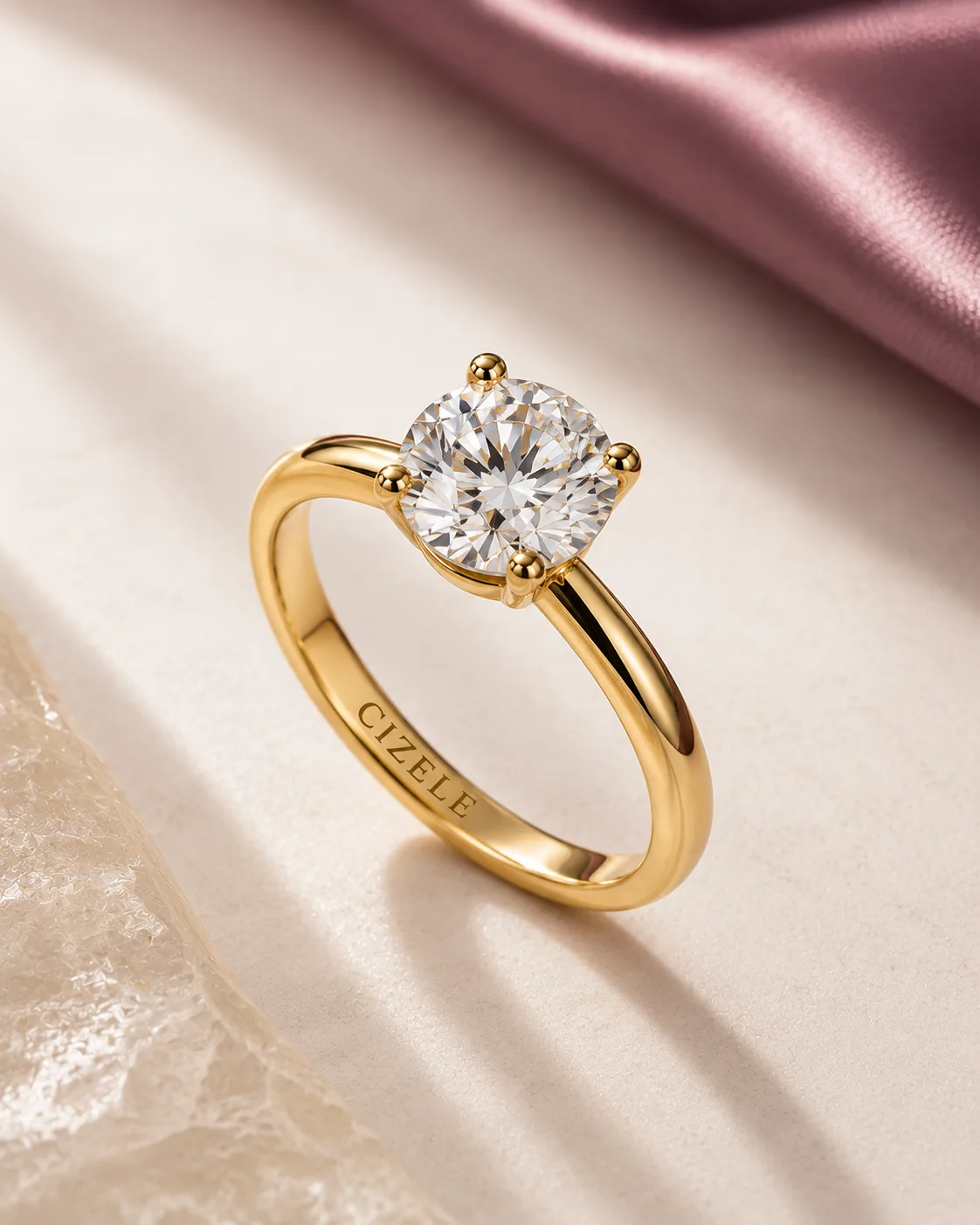
Twine Ring: How It Compares to CIZELE’s Other Designs
Twine ring, compared: which diamond cuts and metals it offers against Vine, Wisteria, Ivy and Twirl, to help you choose between them.
A Twine ring is one of five signature designs in CIZELE’s collection, and the question most people browsing the collection actually have isn’t “what is Twine” on its own, but how it differs from Vine, Wisteria, Ivy and Twirl. This article answers that directly, design by design, using only what each design page actually offers.
What a Twine Ring Offers
The Twine design is built to order around four diamond shapes: emerald, marquise, pear and round. Like every CIZELE signature design, it’s made in solid recycled 18k gold, in rose, white or yellow gold, with a band type of plain, pavé or accents, and a setting profile of either high set or low set. On its default emerald pairing, CIZELE describes the cut as hiding nothing: long step facets read as “architecture rather than sparkle,” suiting someone who wants the quiet confidence of a clean line over maximum flash.
Twine Ring vs Vine Ring
The clearest difference between a Twine ring and a Vine ring is cut range. Vine supports five shapes — emerald, marquise, oval, pear and round — against Twine’s four, adding oval as an option Twine doesn’t offer, covered on its own in oval engagement ring. Both share the same metal choices (rose, white and yellow gold) and the same band and setting options. If an oval cut is the starting point, Vine is the design that supports it; if it isn’t, the two designs offer the same range beyond that one shape.
Twine Ring vs Wisteria Engagement Ring
Wisteria is the more specialised of the two: it supports only oval and pear cuts, against Twine’s emerald, marquise, pear and round. Wisteria is also the only signature design offering two-tone metal as a fourth option, alongside rose, white and yellow gold. Someone wanting a step-cut stone in a wider choice of shapes sits with Twine; someone set on an oval or pear and wanting the option of mixing two metal tones sits with the Wisteria design instead. If the band type chosen on either is pavé, the small stones running along the band are covered generally in the pavé band: a line of light set with small diamonds.
Twine Ring vs the Ivy and the Twirl
These two sit at the opposite ends of the same scale: Ivy offers one cut only, Twirl offers five, and a Twine ring sits between them with four.
Ivy is the narrowest of the five designs by cut range: it supports marquise only. CIZELE describes marquise as “regal and elongating,” cut to stretch a stone to its fullest face-up size for presence on the hand, a cut covered in full in marquise engagement ring. A Twine ring supports marquise too, among its four shapes, so anyone drawn to that cut has a choice between Ivy’s single-cut focus and Twine’s broader range around the same stone.
Twirl is the widest-ranging of the five by cut: marquise, oval, pear, radiant and round, adding radiant as the one shape none of the other four designs offer, including Twine. Metal and band options match across both designs. Where Twine narrows the choice to four shapes built around a quieter, step-cut default, Twirl keeps every option open, including the one cut, radiant, that’s unique to it in this collection and not offered on Twine, Vine, Wisteria or Ivy.
Metal and Band Options Across All Five
Cut range aside, the five designs share the same underlying choices. Each is made in rose gold, white gold or yellow gold, with Wisteria alone adding two-tone as a fourth metal option. Each offers the same three band types — plain, pavé or accents — and the same choice between a high or low setting profile. That consistency is deliberate: it means the decision that actually separates the five designs is the diamond shape each one supports, not the metal or the band construction around it, which makes cut the right place to start when comparing a Twine ring against any of the other four.
Choosing Between Them
None of the five designs is strictly “better” than another; each supports a different combination of cut, metal and setting, and the right one depends on which diamond shape is the actual starting point. A Twine ring is the right comparison to start from if an emerald, marquise, pear or round cut is already decided and a clean, architectural line is the preference over maximum brilliance. From there, Vine, Wisteria, Ivy and Twirl each widen or narrow that choice in one specific direction, as set out above.
Starting Your Own
Every design can be shaped step by step, cut, metal, band and setting, directly on its own page, starting with Twine itself, or browsed together across the full range of rings. If the choice between designs still isn’t clear, a short video consultation talks through the options with no obligation, and Create is the place to start once a direction is settled. For a quick question, message CIZELE on WhatsApp.
