
Marquise Diamond: The Full Guide to the Shape
A marquise diamond gives more face-up area per carat than any other shape. Settings, sizes, symmetry and CIZELE's live stones, explained.
A marquise diamond is a long, pointed-oval cut that gives more face-up area per carat than any other shape, which is why it looks substantially larger than its stated weight. Two sharp points and a curved body mean it also lengthens the finger more decisively than a round, an oval or a cushion of the same size.
What makes a marquise diamond look larger than its carat weight
A marquise diamond spreads a given weight across a longer, shallower outline than almost any other cut, so a 1-carat marquise reads bigger on the finger than a 1-carat round or cushion. Little of the stone’s weight is hidden in depth, and that is also the shape’s one real trade-off: a shallow-cut marquise can show a dark band across its centre, the same bow-tie effect that shows on an oval, and only examining the stone itself, not a certificate, will tell a buyer how visible it is.
What is the right setting for a marquise diamond
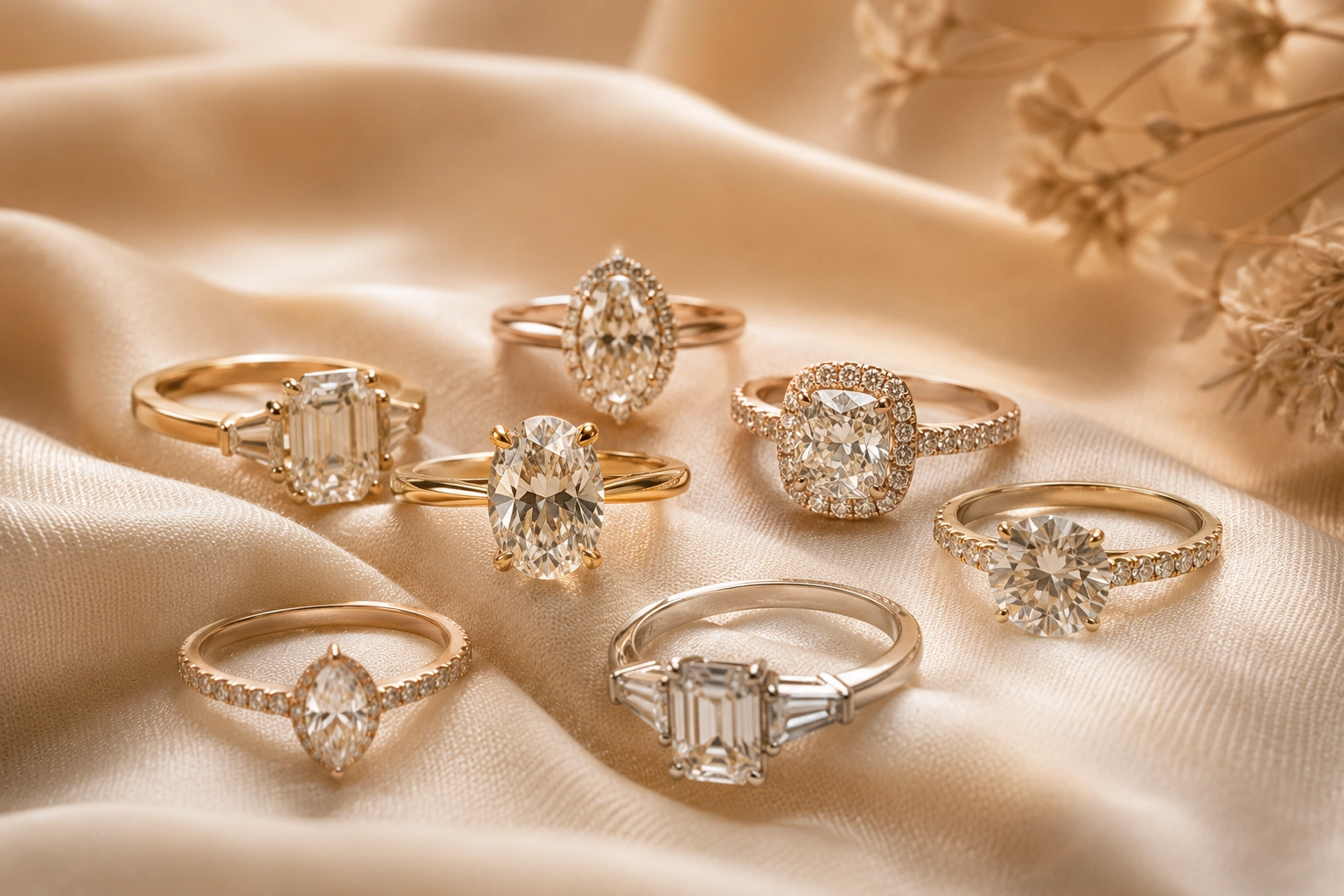
The right setting for a marquise diamond is one with V-prongs at both points, because the two tips are the most fragile part of any diamond and a prong that clamps across them rather than wrapping them will eventually chip the stone. CIZELE sets marquise stones in solitaire, bezel and east-west, where the stone is turned sideways across the finger for a quieter, more contemporary look than the classic point-to-point orientation. A plain band keeps the eye on the outline; accents tapering toward the points extend the line further. CIZELE’s twine takes a different route — a crossed, vine-like double band that cradles the stone where it meets — and marquise is one of the cuts it is built around.
Symmetry matters more on a marquise than on almost any other cut
A marquise diamond is judged on symmetry in a way a round brilliant is not: the two halves either side of the long axis must mirror each other, and the points must sit on a straight line through the centre, because the eye reads that long axis first and any drift is immediately visible. Cut grading on a marquise is judging the specific stone’s proportions rather than a universal ideal, since the shape has no single fixed set of angles the way a round does.
What length-to-width ratio should a marquise diamond be
Around 1.85 to 2.10 length-to-width is the classic marquise proportion, the point where most buyers feel the shape reads as dramatically elongated without looking strained. Worn along the finger it is unmistakably vintage; turned east-west, as above, it reads modern and quietly unusual. Either way, the ratio is a matter of taste rather than a right answer, and it is worth deciding on purpose rather than by accident.
Why colour and clarity read differently on a marquise
Because a marquise diamond is shallow and its points carry little weight, body colour and inclusions can concentrate visibly near the tips even when the stone’s overall colour and clarity grades look clean on paper. The certificate, GIA or IGI, remains the only reliable way to compare two marquise stones before seeing them side by side, since a photograph will not show where a colour concentration or an inclusion sits relative to the points.
How a marquise compares to a pear for apparent size
A marquise diamond is often compared with a pear, since both are elongated shapes with at least one point to protect, but a marquise has two points instead of one and no rounded end to anchor the eye. That makes a marquise read as more purely linear on the finger, where a pear’s rounded top gives it a slightly more traditional silhouette. For a buyer deciding purely on apparent size per carat, the two shapes are close; the decision usually comes down to whether a single point or two points suits the hand and the rest of the ring better, which is worth testing on the hand rather than deciding from a photograph alone.
How many carats should a marquise diamond be
There is no fixed answer, because a marquise diamond’s unusually efficient spread means a given carat weight looks larger here than it would in almost any other shape. A buyer coming from a round or a cushion and shopping by carat weight alone will generally find a marquise of the same weight looks noticeably larger once set, which means it is possible to buy a smaller stone by weight and still land on the apparent size that was the original goal. That trade-off is worth discussing directly in a consultation rather than assuming the same carat number will transfer cleanly between shapes.
Starting a marquise diamond ring
CIZELE’s shape archive for marquise lists live marquise stones by carat, colour and clarity, lab-grown and natural, each independently certified. A guide to carat and apparent size is worth reading before comparing two marquise stones on weight alone, since the shape’s long, shallow outline changes that maths more than most. If a marquise engagement ring itself, rather than the stone and setting, is the starting point, CIZELE’s marquise engagement ring guide covers that ground. Design a ring around a marquise diamond once a specific stone stands out, or message CIZELE on WhatsApp with a question about a stone. A video consultation is a good next step for a second opinion with no obligation.
