
Emerald Cut Diamond: The Full Buying Guide
An emerald cut diamond hides nothing: step facets, clarity, colour, setting and how to choose one from CIZELE's live inventory.
An emerald cut diamond is a rectangular step cut with long parallel facets running down the pavilion, which produce broad flashes of light and shadow rather than the scattered brilliance of a round. The effect is usually described as a hall of mirrors, and it is a shape that rewards looking into rather than looking at. The proportions are typically close to rectangular rather than square, though a squarer step cut exists under a different name, and the two are easy to confuse in a photograph where lighting can flatten the difference.
Why an emerald cut diamond shows clarity more than a round does
An emerald cut diamond shows inclusions and body colour more plainly than a brilliant cut of the same size, because its open table has no scattered facets to break up the light and disguise them. A stone that would pass unnoticed as a round can look flawed here, so an emerald cut needs a higher clarity grade and a colder colour grade than a round of the same apparent quality. Most buyers find it worth shifting the budget toward clarity and away from cut on an emerald cut stone, since cut has less room to disguise a flaw than on a faceted shape.
What is the right setting for an emerald cut diamond
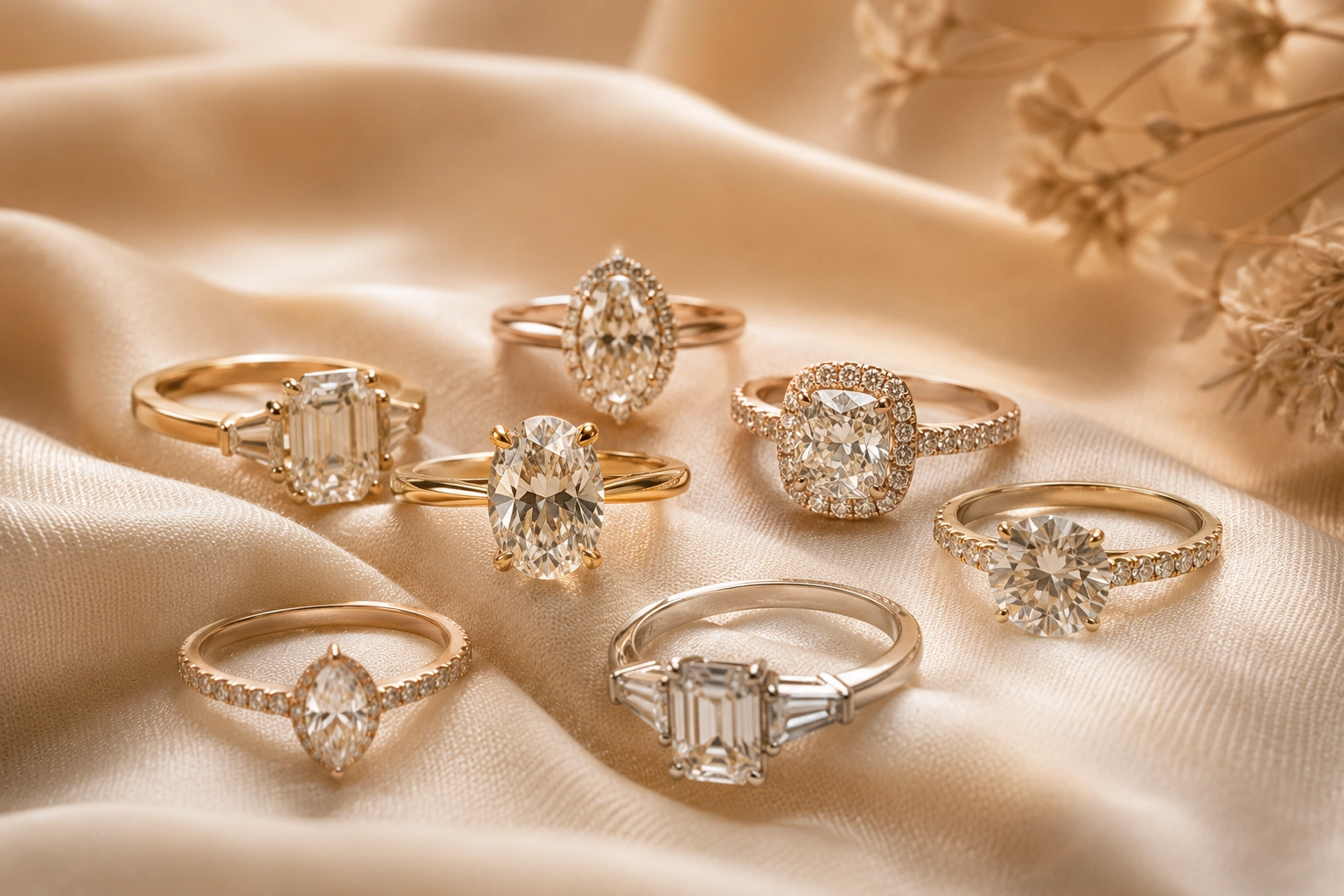
CIZELE sets emerald cut diamonds as a plain solitaire, where the long rectangle reads severe and confident, or as toi et moi, two stones set side by side and balanced against each other. Flanked by tapered baguettes it becomes properly Art Deco, which fits the cut’s history: it was originally developed for emeralds, where the stepped design relieved the pressure that cracked more brittle crystals, and it kept the name once it moved across to diamond.
How the step cut shows clarity differently from a faceted shape
The step cut’s broad, flat facets act almost like a window into the stone, so a clean area reads completely clean and an inclusion sits in plain view rather than scattered among dozens of smaller reflections. The certificate, GIA or IGI, becomes essential reading here rather than a formality, because the clarity plot on it will show roughly where an inclusion sits, and a stone with an inclusion tucked under a prong setting can look cleaner worn than its grade alone suggests.
How big does an emerald cut diamond look for its carat weight
An emerald cut diamond is shallow relative to its weight, so it presents a larger face for its carat than a deep round of the same weight, and the cropped corners make it stable and straightforward to set. That shallowness is also why two emerald cut stones of the same carat weight can look different sizes once mounted, since the actual length and width of the table, not the weight alone, decide how large the stone reads on the finger. The carat and size guide covers that trade-off across every shape CIZELE sets, which is worth reading before comparing two emerald stones on weight alone.
How an emerald cut differs from the shapes near it
An emerald cut diamond is architectural rather than romantic, and buyers choosing between shapes usually compare it against two others: the oval, which is brilliant-faceted and forgives colour and clarity more readily, and the asscher, a squarer step cut with the same hall-of-mirrors character in a more compact outline. If the ring itself, not just the stone, is the question, CIZELE’s emerald engagement ring guide covers settings, metals and proportions for the finished piece.
What length-to-width ratio should an emerald cut diamond be
Most emerald cut diamonds fall between about 1.30 and 1.50 length-to-width, and around 1.40 is the proportion most buyers read as the classic rectangle. Below roughly 1.25 the outline starts to look square and moves toward asscher territory; above about 1.60 it reads as a long, narrow slab, which some people want deliberately and others find unbalanced once it is on a hand. The ratio is printed on neither grade nor certificate as a verdict, only as the measurements it is calculated from, so it is worth working out for any two stones being compared rather than judging from a photograph. It also changes how much metal frames the stone’s long facets, which shows more on a step cut than on a brilliant one, because visible metal at the edge reads as a clean line rather than disappearing into sparkle.
How does an emerald cut diamond wear day to day
Because an emerald cut diamond has cropped rather than sharp corners, it is reasonably secure to wear daily, though the long, flat table sits slightly more exposed than a deep round of the same carat and can show surface wear on the facet edges sooner on a very active hand. A bezel-style frame around the stone, which wraps metal further up the sides, is worth asking about for anyone who works with their hands regularly, since it protects the exposed corners without changing the stone’s visible length.
Starting an emerald cut diamond ring
CIZELE’s shape archive for emerald lists live emerald cut stones in inventory by carat, colour and clarity, lab-grown and natural, each independently certified. Design a ring around an emerald cut diamond once a specific stone stands out, or talk to CIZELE on WhatsApp with a question about a particular stone. A video consultation is a good next step for a second opinion with no obligation.
