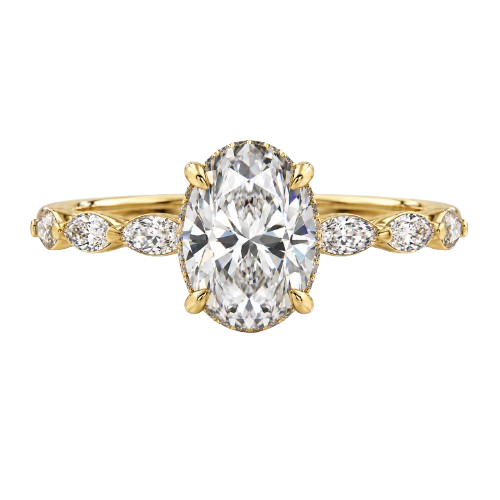

Bezel Setting: The Ring for Hands That Work
A bezel setting wraps a rim of metal around the diamond's edge. Why it protects the stone, sits flush, and suits hands that work every day.
A bezel setting is a rim of metal that runs around the entire edge of a diamond, holding it in place from the side rather than with prongs from above. That rim protects the stone’s girdle from knocks and lets the ring sit flush against the finger, which is why it is the setting people choose when their hands do real work all day rather than sit still for a photo.
What is a bezel setting, exactly?
Instead of metal claws gripping the stone at a few points, a bezel wraps a continuous band of metal around the diamond’s outer edge, level with or just above the surface of the ring. The whole rim does the holding, so there is no single prong to catch, bend or snag on a sleeve, a glove or the inside of a pocket. Some bezels run fully around the stone; others leave the sides more open while still enclosing the vulnerable edges.
Who actually chooses a bezel setting?
The honest answer is people whose hands are not just for display. Cooks, nurses, mechanics, anyone who types, lifts or washes constantly: a bezel keeps the diamond low and enclosed, so it survives a day of real use rather than a display case. It is also a common second-ring choice for someone who loves their solitaire engagement ring but wants a separate piece to wear without thinking about it, for gym days or manual work.
Does a bezel setting protect the diamond better?
Enclosing the girdle in metal on all sides shields it from the kind of edge-on knocks that chip a stone, which is the main damage risk for a diamond in daily wear. It also means less metal stands proud of the finger to catch on things, since the setting sits close to flush rather than raised on prongs. That combination, less exposed edge and a lower profile, is the practical case for a bezel over almost any other setting.
Does a bezel setting make a diamond look smaller?
It can, a little. Because the metal rim covers part of the diamond’s edge and there is less open space around the stone for light to enter from the side, a bezel-set diamond often reads as slightly smaller and more contained than the same stone in a solitaire, where the sides are fully open to light. Some people choose it for exactly that quieter, lower profile; others find it changes the sparkle more than they want. Seeing the same stone in both is the only reliable way to know which you prefer, which is one reason CIZELE builds each ring around a specific stone rather than a catalogue.
How does a bezel compare to a halo?
A halo surrounds the centre stone with a ring of smaller diamonds to add size and sparkle around it. A bezel surrounds it with plain metal to add protection and a flush profile. They solve different problems, more visual presence versus more durability, so choosing between them comes down to which one you actually need day to day rather than which looks better in a single photo.
Which metals and shapes work in a bezel setting?
CIZELE builds a bezel in any of its recycled golds, yellow, white or rose, around any of the ten diamond shapes, natural or lab-grown. Rounder shapes like round and oval sit especially cleanly inside a bezel’s continuous rim; more angular shapes such as emerald or princess can work too, built around the specific stone rather than a standard template.
Is a bezel setting suitable for a wedding band as well?
Yes, and it turns up there for the same reason: a wedding band is worn every day without exception, often on the hand that does the most physical work, so a flush, protected profile suits it as well as it suits an engagement ring. Anyone weighing a bezel band alongside other options can see the full range of comfort-fit wedding bands CIZELE builds.
How does a bezel setting compare to accent stones down the band?
Differently again. Accent bands add smaller diamonds along the band itself, which is about the shoulders either side of the centre stone, not the centre setting. A bezel is purely about how the main stone is held, so the two aren’t competing choices: a centre diamond can sit in a bezel while the band beside it still carries accents, if that’s the look someone wants.
Does a bezel work for a promise ring or a smaller stone?
Yes, and it is arguably an easier decision there. A promise ring often carries a smaller stone worn daily well before any engagement, so the same practical case, protection from knocks, a flush profile, applies just as much, if not more, since a smaller ring tends to see rougher daily handling than one reserved for special occasions.
If a bezel setting fits how you actually live day to day, start designing on /create/ with your own stone and metal, or talk it through on WhatsApp first: wa.me/201501605724. A private video consultation is also available if you want to see a bezel next to a solitaire before deciding.