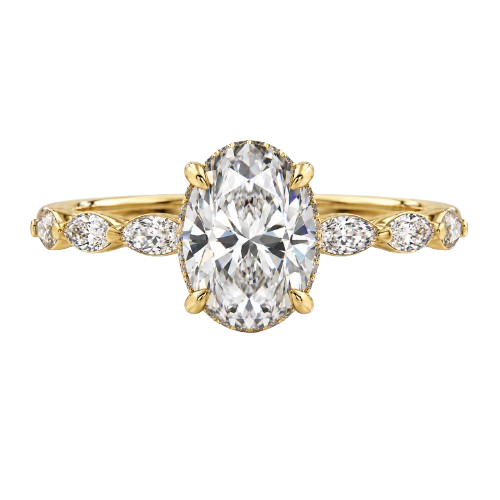

How to Know You Have a Real Diamond
A real diamond is verified by an independent grading report, not a home trick. What GIA and IGI certificates confirm, and why lab-grown counts too.
You verify a real diamond by an independent grading report you can look up yourself, not by breathing on it or dragging it across glass. A lab-grown diamond is a real diamond too: it is chemically, physically and optically the same crystal as one formed underground, and it is graded by the same bodies. The only stones that are not real diamonds are imitation stones, which a proper grading report identifies immediately.
What actually makes a diamond “real”?
A real diamond is a specific crystal: carbon, arranged in a particular lattice, with a defined hardness, refractive index and way of handling light. That definition does not care whether the crystal grew a hundred kilometres underground over a billion years or in a lab over a few weeks. Both processes produce the same mineral, and neither is an imitation stone pretending to be something it is not. What is not a real diamond is a different material altogether, shaped and polished to resemble one.
Is a lab-grown diamond a real diamond?
Yes. A lab-grown diamond has the same chemical composition, the same crystal structure and the same optical properties as one mined from the earth. Gemmological laboratories, including GIA and IGI, grade lab-grown stones on the same 4Cs scale as natural ones, and print “laboratory-grown” clearly on the report rather than treating it as a lesser category. The origin is different; the mineral is not. If you are weighing natural against lab-grown for your own ring, our guide to lab-grown and natural diamonds sets out how each is priced and how each looks, and a separate piece on lab-grown diamonds in Egypt covers how buying habits here have shifted.
Why home tests do not settle it
Fog tests, scratch tests and float tests are popular because they are free and immediate, but every one of them can be passed by common imitation stones as well as by a real diamond, and every one of them can be failed by a real diamond that is dirty or poorly cut. None of them measure anything a jeweller would rely on. The only reliable answer comes from a laboratory that examines the stone under controlled conditions and states, in writing, exactly what it is.
What an independent grading report actually proves
A report from GIA or IGI records the stone’s carbon origin (natural or laboratory-grown), its carat weight, cut, colour and clarity grade, and a unique report number you can look up on the issuing laboratory’s own website to confirm the report matches the stone. That lookup is the real test: not what the seller tells you, but what an organisation with nothing to gain from the sale has independently recorded. You can check any report number directly at gia.edu or igi.org before you commit to buying.
What CIZELE certifies
Every stone CIZELE sets, natural or lab-grown, is drawn from live inventory and certified by GIA or IGI before it goes into your ring. That certificate travels with the piece, so what you were shown, what was set and what you can verify independently are always the same stone. Our own guide to reading a certificate walks through what each line on a GIA, HRD or IGI report actually means, so you are not relying on anyone’s word for it, including ours.
What to ask before you buy anywhere
Ask for the report number before you pay a deposit, not after. Ask which laboratory issued it: GIA and IGI are internationally recognised, and a report number you cannot verify on the issuer’s own site is not evidence of anything. If a seller cannot produce a report at all, or offers a private “certificate” from an unnamed lab, treat that as the actual warning sign, whatever the stone itself looks like under a loupe. A stone’s setting matters too: a classic solitaire or a round brilliant cut can carry either a genuine or an imitation stone, so the setting tells you nothing about what is actually mounted in it.
Starting your own ring
If you are choosing a diamond for an engagement ring or a piece of your own, the certificate is the place to start, not the last thing you check. You can begin designing on /create/, where every stone shown is drawn from certified, live inventory, or book a private video consultation to talk through natural against lab-grown before you decide. For a quicker question, message CIZELE on WhatsApp and a designer will reply directly.