Diamond Cut Explained: Why It Matters More Than Carat
Diamond cut explained: the proportions behind light return, how the grades work, and why cut affects sparkle more than carat weight does.
Diamond cut is the grading criterion that measures how well a stone’s proportions, symmetry and angles return light to the eye, and it is graded from Excellent to Poor. Cut is not the same as shape: a round, an oval or a princess diamond can each be cut anywhere from Excellent to Poor, and the cut grade is what decides how much a stone sparkles, not which outline it has.
What is diamond cut, exactly?
Diamond cut describes the angles and finish a stone was worked to, not the outline it was worked into. A diamond’s facets act like small mirrors: cut correctly, they bounce light back up through the top of the stone; cut too shallow or too deep, light leaks out of the sides or bottom instead and the stone looks duller than its clarity and colour would suggest. Cut is one of four grading criteria on a certificate, alongside colour, clarity and carat, and every diamond CIZELE sets is certified GIA or IGI, covered fully in the guide to understanding your certificate.
Diamond cut vs shape: not the same thing
Shape is the outline a diamond is cut into: round, oval, princess and CIZELE’s other shapes are all shapes, not cut grades. Cut is a separate measurement of how well any given shape was proportioned once the rough stone was cut down. A well-cut princess and a poorly cut princess look completely different under light even though they are the same shape and can carry the same carat weight. Buyers who ask for “a good cut” usually mean both at once: the shape they want, at a cut grade high enough that it actually sparkles.
The cut grades, from Excellent to Poor
GIA and IGI both grade cut on a five-step scale: Excellent, Very Good, Good, Fair and Poor, based on measured proportions, symmetry and polish rather than opinion. Excellent and Very Good return the most light and are the grades CIZELE works from for a stone meant to catch light in daily wear. Good can still look bright depending on the specific proportions, but Fair and Poor stones lose noticeably more light out of the sides or bottom of the stone, a loss no setting can correct afterwards. The scale is set out in detail on gia.edu.
Why cut matters more than carat for how a stone looks
Two diamonds of the same carat weight, colour and clarity can look completely different depending on cut, because cut is what determines how much of the light entering the stone actually reaches the eye. A smaller, well-cut diamond routinely reads brighter and larger-looking than a bigger diamond cut too shallow or too deep, which loses light through the sides instead of back up through the table. This is why CIZELE weighs cut ahead of carat when a client is choosing between two stones on a budget, a trade-off also covered in the guide on how much you should actually spend on an engagement ring.
How cut interacts with setting and shape
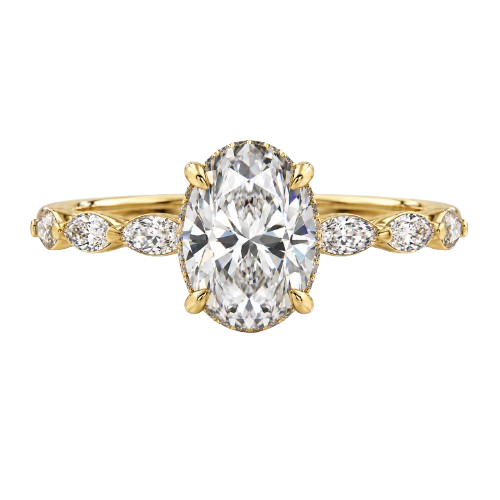
A high cut grade is easiest to see in a setting that leaves the stone open to light from every angle, which is part of why a classic solitaire is such a reliable way to show off a well-cut stone: there is nothing else for the eye to weigh it against. Shapes also behave differently at the same cut grade; a round brilliant has a facet pattern refined specifically to maximise light return, while fancier shapes like oval or princess depend more on precise proportions to avoid dark or washed-out patches. This is one of the details worth checking on video before a stone is chosen, alongside clarity and the shape’s own proportions.
A setting that partly covers the stone’s sides, such as a bezel, changes how much of the cut’s light return is visible compared with an open-claw setting, since a bezel blocks some light from entering or leaving through the sides of the stone. Neither approach is wrong, but it is worth knowing that a stone’s cut grade was measured unset, and how it reads afterwards depends partly on the setting chosen around it.
Lab-grown or natural: does cut differ?
Cut is graded the same way regardless of origin, because lab-grown and natural diamonds are chemically and optically identical stones, cut by the same standards. CIZELE sets both from certified inventory, and the difference between the two is set out fully in the guide to lab-grown vs. natural diamonds. A high cut grade is available in either, so origin does not need to be weighed against sparkle.
Choosing a diamond by cut with CIZELE
The most reliable way to judge cut is to see a specific stone under light rather than read a grade in isolation, since two stones with the same certificate number can still look different depending on exactly how their proportions were finished. A ring can be designed shape by shape in the ring builder, with the diamond matched afterwards from certified inventory at a cut grade checked before it is set. To talk through cut, shape and budget together, message CIZELE on WhatsApp at +20 150 160 5724, or book a private video consultation before any stone is chosen.