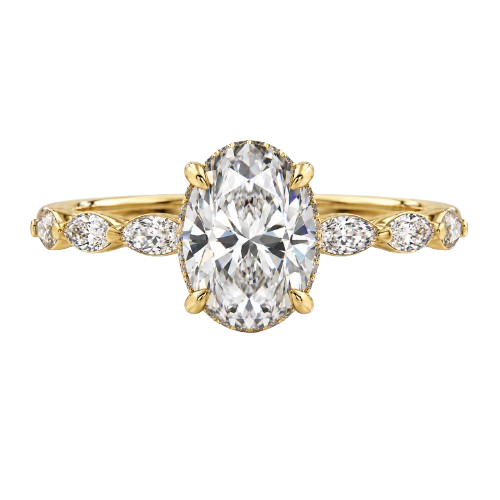

The Halo: A Ring of Smaller Diamonds, Doubling the Light
A close-set ring of small diamonds that makes your center stone look larger and sparkle harder, in six distinct variations.
A close-set ring of small diamonds around the center stone. It does two things a solitaire can’t: makes the center stone read larger, and adds a second layer of sparkle around it. Once an Art Deco signature, it is now one of the most requested settings we make.
- More presence: a well-set halo makes the center stone read noticeably larger than its actual carat weight.
- Six real variations exist, not one, from a classic ring of pave to a halo hidden entirely beneath the stone.
- Pairs best with a curved or contoured wedding band, not a plain straight one.
- More upkeep than a solitaire, more settings mean more to clean and check.
Why a halo works, optically
A halo is not decoration for its own sake. Small diamonds set close around a center stone do two specific things: they close the visual gap between the stone and the metal, so the eye reads the stone and its frame as one continuous area of brilliance, and they throw extra light into exactly the zone surrounding the center stone, the place your eye lands first. The result is a ring that looks and sparkles larger than the center stone alone would justify, without the added cost of a larger center stone.
It is also, quietly, protective. The raised prongs that hold a center stone are its most vulnerable point in daily wear. A halo’s surrounding metalwork lowers the stone’s visual and structural profile, cushioning it against the kind of everyday knocks a bare solitaire absorbs alone.
Six ways to wear a halo
“Halo” describes a family of settings, not one fixed look. Each variation changes the ring’s presence in a different way.
One ring of pave diamonds framing the center stone. The original, and still the most requested, halo.
Two concentric rings of pave. Significantly more sparkle and visual size, for a center stone that wants real presence.
Set beneath the center stone, invisible from above, catching light only from the side. A quiet boost with no change to the ring’s silhouette.
A scalloped or beaded metal edge around the halo, an Edwardian and Art Deco signature, for a ring that reads as an heirloom from day one.
Set with a fine gap beneath the ring of stones, so the halo appears to hover just above the band. Lighter and more delicate than a flush-set halo.
The halo itself is cushion-shaped, softly rounded at the corners, regardless of the center stone’s own cut. A romantic, vintage-leaning silhouette.
A ring of light around the stone you already love.
Who chooses a halo, and when
A halo is most often chosen by someone who wants their ring to have real presence on the hand without stretching the center-stone budget to do it. It is a genuinely popular first-engagement-ring choice for exactly that reason: more visual size and sparkle per carat than a solitaire gives alone.
It is also a common choice for a vintage-inspired proposal, particularly the milgrain and cushion variations, and for anniversary upgrades, where a client already owns a solitaire and wants to add presence to an existing stone rather than replace it entirely.
Styling it well
A halo sits wider at its base than the center stone alone, which matters most when it meets a wedding band. A plain, straight band often leaves a visible gap against a halo’s curved edge. We cut most halo pairings as a curved or contour band, shaped to follow the halo’s exact silhouette so the two rings sit flush, worn together or alone.
On the hand, a halo reads as more visual width across the top of the finger than a solitaire of the same carat weight, a detail worth feeling on your own hand before deciding, not just seeing in a photograph.
Halo or solitaire, how to decide
Neither is the “correct” choice, they answer different questions. Choose a solitaire if you want the center stone itself, its cut, its clarity, to be the entire conversation, with nothing surrounding it to share credit. Choose a halo if you want more visual size and light than your center-stone budget alone would buy, and you don’t mind a slightly busier setting to clean.
Cost efficiency is real, not a sales line: a well-cut halo around a smaller center stone can read larger, and sparkle harder, than a bigger solitaire at a similar total price, because the light-return job is being shared across many small stones instead of asked of one.
Living with a halo
More stones means more settings to inspect. We recommend a professional check and clean roughly twice a year, more often than a solitaire, since lotion and soap residue collects more easily in a halo’s closer stone-to-stone spacing. None of this is a reason to avoid a halo, only a reason to actually do the maintenance, which we’re always happy to do for anything we’ve made.