The Solitaire: One Stone, Nothing to Distract From It
The oldest, most enduring engagement-ring silhouette, in five real prong styles, and why cut quality matters more here than anywhere else.
One diamond, minimal metal, nothing competing for attention. The oldest and most enduring engagement-ring silhouette, and still the one every other setting is judged against.
- Cut quality matters most here: with nothing else to look at, a weak cut has nowhere to hide.
- Prong style changes the whole feel, from a classic four-prong to a rounder six-prong Tiffany-style setting.
- Pairs with any wedding band, the simplest silhouette to build a stack around.
- Lowest long-term maintenance of any setting, fewer places for residue or damage to collect.
Why simplicity is the hardest thing to get right
A solitaire has no halo, no side stones, no surface detail to distract from the center diamond. That is precisely its demand: the stone itself has to earn the ring. We recommend directing your budget toward the best cut grade your carat range allows here specifically, since a solitaire is the one setting where cut quality reads immediately and completely, with nothing to soften a weaker one.
It is also the setting that ages best. A halo or a heavily detailed setting can read as belonging to a particular decade; a well-proportioned solitaire, in the right prong style, has looked correct for over a century and will keep looking correct.
Five prong styles, one philosophy
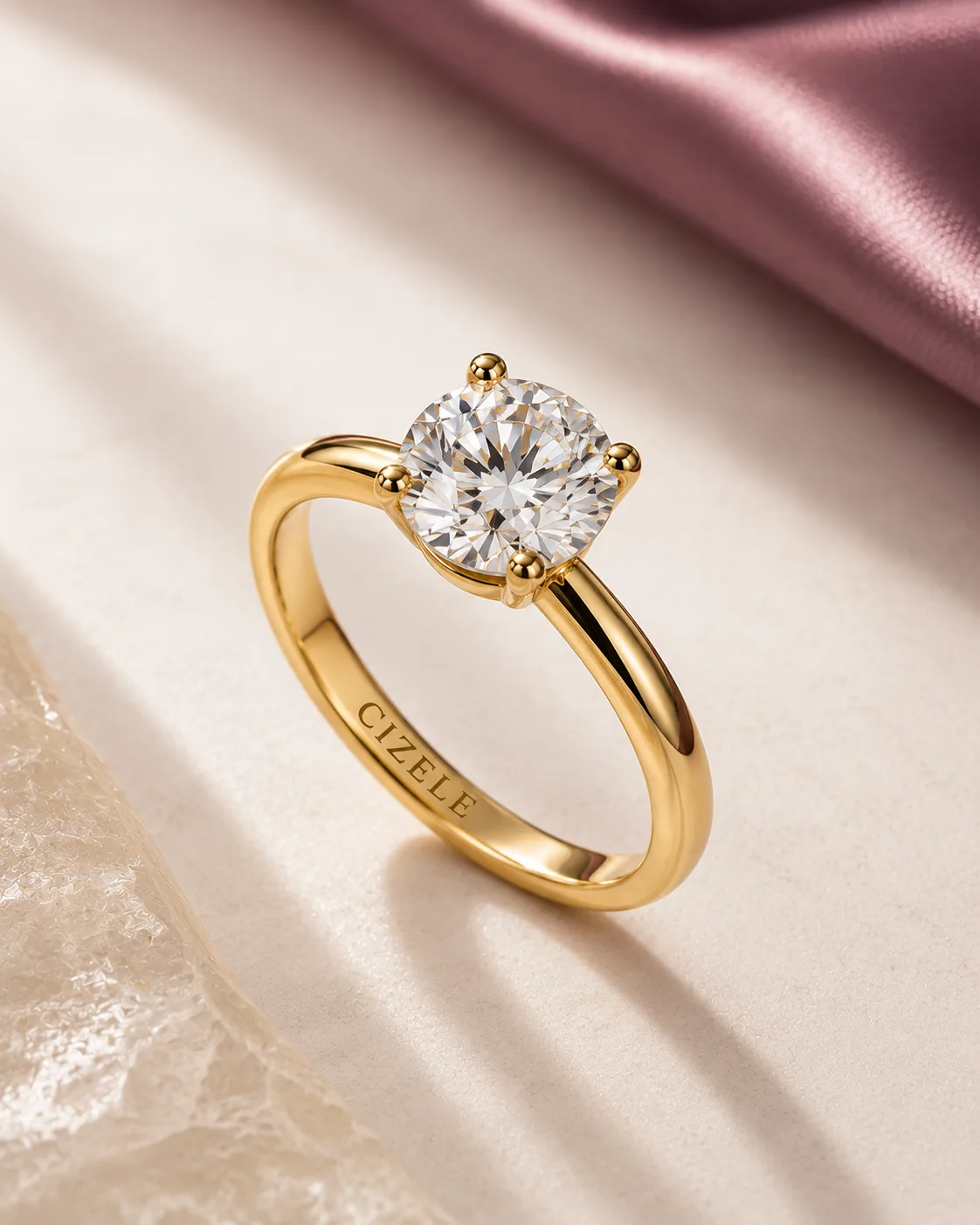
The most common solitaire setting, showing the maximum amount of the stone with minimal metal. Slightly less secure than six-prong, though entirely sound for daily wear.
Named for the 1886 Tiffany setting that popularized it. More secure, and reads as a rounder silhouette even on non-round stones.
The band rises in two arches toward the stone before meeting the prongs, lifting the diamond and adding a quietly architectural profile.
The band tapers to a thin, faceted ridge rather than a rounded profile, a subtly sharper, more modern read on a classic shape.
Crossing, woven-looking metal strands lead into the prongs, a more decorative solitaire without adding a second stone.
Each point doubled for extra security on larger stones, at a very slight cost to how much of the stone shows.
Nothing between the diamond and the hand wearing it.
Who chooses a solitaire, and when
The solitaire remains the default first choice for a reason: it is the least risky decision when you are choosing for someone else’s taste, or when neither of you has a strong opinion yet about setting style. It is also the deliberate choice of clients who specifically want the diamond, not the setting, to be the entire statement, often those who already know exactly which cut and quality they want.
Styling it well
A solitaire’s narrow profile is the easiest of any setting to pair with a wedding band, curved, straight, pavé or plain all sit comfortably against it. This is also the setting most easily upgraded later: a hidden halo or a delicate band of pavé can be added years afterward without redesigning the ring.
Solitaire or halo, how to decide
If your priority is the diamond itself, its cut, its clarity, being the entire conversation, choose the solitaire. If you want more visual size and sparkle than your center-stone budget alone provides, the halo answers a different question. Neither is more “correct,” they optimize for different things.
Living with a solitaire
Fewer settings mean less to maintain. We still recommend a professional prong check roughly once a year, since prongs are the one part of any solitaire that wears with time, but day to day this is the lowest-maintenance setting we make.