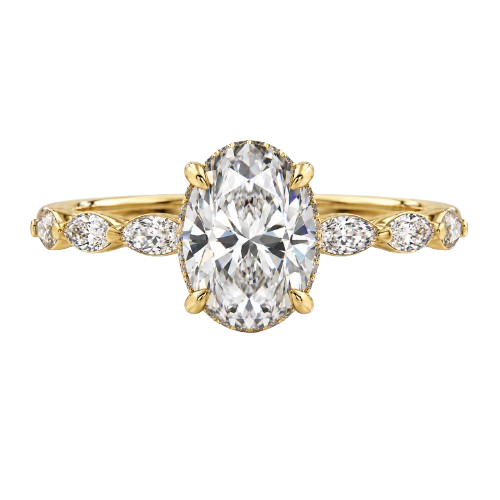
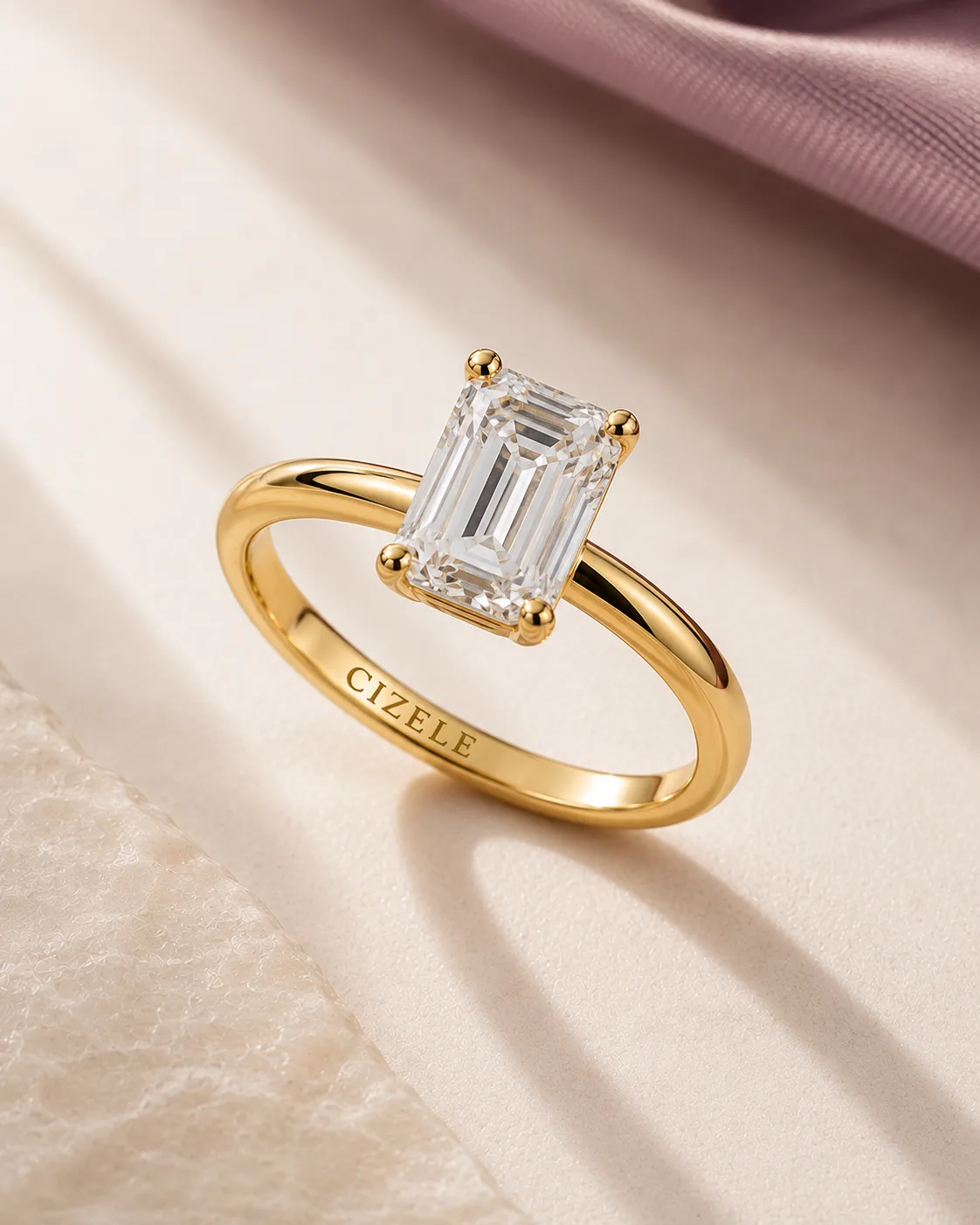
Gold Pendant: Bail, Setting and Chain Weight
Choosing a gold pendant: how the bail attaches, setting a stone or initial into gold, and matching pendant weight to a chain that can carry it.
A gold pendant is decided by three things that have nothing to do with the chain it hangs on: the bail that attaches it, how a stone or initial is set into the gold, and whether its weight suits the chain carrying it. This article is about the pendant itself, not the chain: karat, chain weight, clasp, length and hallmarking are a separate set of decisions.
The bail is what actually holds a pendant on
The bail is the small loop or fitting that the chain passes through, and it is the part of a pendant most likely to wear thin or bend over years of use, since all the movement and weight concentrates there. A fixed bail is soldered directly to the pendant and does not move; a bail with a small jump ring or hinge allows the pendant to hang and turn more freely but adds a joint that can eventually work loose. A pinch bail grips the top edge of a flat piece, a coin or a slice of stone, rather than passing through a drilled hole, avoiding weakening the piece but relying entirely on the grip holding over years. A wider, flatter bail spreads wear across more metal than a thin wire loop, which matters more the heavier the pendant is.
A bail also has to be sized to the chain it hangs on, not just to the pendant. Its inner width has to clear the chain’s link or wire gauge with room to move freely, but not so much room that the pendant tips sideways rather than hanging straight. A bail cut too tight binds against the links and wears a groove into both over time; one cut too loose lets the pendant swing and rattle, and that rattle is usually where the fastest wear happens, since it means metal striking metal on every movement rather than settling still. A pendant is rarely moved freely between chains of very different weights for the same reason: a bail sized for a fine box chain often will not sit correctly on a heavier curb chain.
Weight does not load a chain evenly once a pendant is added: nearly all of it concentrates at the bail and the links nearest it, not across the whole length the way the chain’s own weight does. That is why the two or three links closest to a pendant are usually the first to show stretching on a chain that has carried real weight for years, well before the rest shows any wear. If a pendant is being made rather than bought off a shelf, ask specifically how the bail is attached, how thick it is, and whether its inner width has been matched to the chain, the same way you would ask about the gold colour or finish of the rest of the piece.
Setting a stone, an initial or an engraving into gold
A pendant carries its decoration in one of three ways: a stone set into a prong, bezel or pavé setting; a solid shape such as an initial or symbol cast from the gold itself; or an engraving cut into a flat or curved surface. Setting a stone into a pendant follows the same logic as setting one into a ring, starting with shape, but a pendant turns against clothing and skin all day, so a setting needs to hold securely from every angle, not just from above, which decides open versus closed backing. An open, unbacked setting lets more light into the stone from behind, showing more of its true colour and brilliance, but exposes the stone’s girdle to knocks and catches on clothing and hair as the pendant turns. A closed setting backs the stone with solid gold, protecting it and smoothing the underside, at some cost to light reaching the stone from below. A bezel, a rim of gold around the stone’s edge, is usually closed and the more forgiving choice for daily wear, since it protects the stone’s edge from knocks a ring rarely takes. An initial or engraved pendant avoids a setting entirely and relies on the thickness of the gold itself to resist bending, which is why a thin cast initial can flex and crack at a corner over years of wear. If a diamond is the centre of the piece, our diamond pendant guide covers how the stone is matched and set as its own bespoke commission, a more detailed process than setting a small accent stone into a gold shape.
Matching pendant weight to chain strength
A pendant that is too heavy for its chain pulls the chain out of shape over time, stretching links nearest the clasp and pendant faster than the rest, and in the worst case can open a weak clasp altogether. As a rough rule, a fine chain suits a small, light pendant worn every day, while anything with real weight, a larger stone, a solid gold shape, a locket, needs a heavier-gauge chain to carry it without distorting. A chain has to be chosen around what it will carry, not chosen first and matched to a pendant afterwards.
Where a diamond changes the piece
A plain gold pendant, an initial, a small shape, a flat disc, works as an everyday piece that does not centre on a single stone. Once a diamond becomes the focus, the pendant is really a setting built around a certified stone, and the questions shift toward carat, cut and certificate rather than gold weight alone. Our diamond necklace guide covers that in full, including how the stone and chain are matched as one commission; our guide to reading a certificate explains what a GIA or IGI report actually confirms before a stone is set.
Building a gold pendant with CIZELE
CIZELE does not sell a ready gold pendant off a shelf; every piece is designed and made to order, hand-finished, and set with a certified diamond, natural or lab-grown, from live inventory where the design calls for one. A design begins on /create/ or in a private video consultation, and lead time runs about two to six weeks from consultation to finished piece. If the piece in mind is a plain gold initial or shape rather than a diamond-set pendant, the simplest next step is to ask directly on WhatsApp whether it is something CIZELE can make for you.