Diamond Clarity Explained: What Grade Should You Buy?
Diamond clarity grades explained: what FL to I3 mean, which shapes hide inclusions, and which grade still looks clean to the eye once it is set.
Diamond clarity measures how many tiny inclusions or surface marks a stone has, graded on a scale from Flawless to Included. Most inclusions at the higher grades are invisible without magnification, so for an engagement ring the practical question is not “what is the highest grade” but “what is the lowest grade that still looks clean to the eye.” A stone one or two grades below flawless is usually indistinguishable once set, at a real difference in price.
What is diamond clarity in an engagement ring?
Diamond clarity is one of the four grading criteria on a diamond’s certificate, alongside cut, colour and carat, and it describes internal inclusions and external blemishes formed as the stone grew. Every diamond CIZELE sets is graded GIA or IGI, the standard covered in CIZELE’s guide to understanding your certificate, and clarity is one line on that same report. A higher clarity grade means fewer and smaller marks, not a different diamond in any other respect.
Clarity is also the grading criterion buyers tend to overweight, because it is the easiest of the four Cs to picture as a simple “cleaner is better” scale. In practice, the useful question is narrower: at what grade does an inclusion stop being visible without magnification, for the specific shape and size being considered. Below that point, paying for a higher grade buys a certificate number rather than a visible difference on the hand.
The clarity scale, from Flawless to Included
The scale runs Flawless (FL), Internally Flawless (IF), Very Very Slightly Included (VVS1, VVS2), Very Slightly Included (VS1, VS2), Slightly Included (SI1, SI2), and Included (I1 to I3). FL and IF stones have no inclusions visible under 10x magnification; VVS stones have inclusions so small they are difficult to find even with a loupe; VS stones have inclusions that are minor and usually invisible to the naked eye; SI stones can show inclusions under close inspection, and some are visible without magnification depending on size and position. I-grade stones typically show inclusions to the naked eye. The reference chart on gia.edu sets out each grade in more detail than a summary can.
Which diamond shapes hide inclusions best
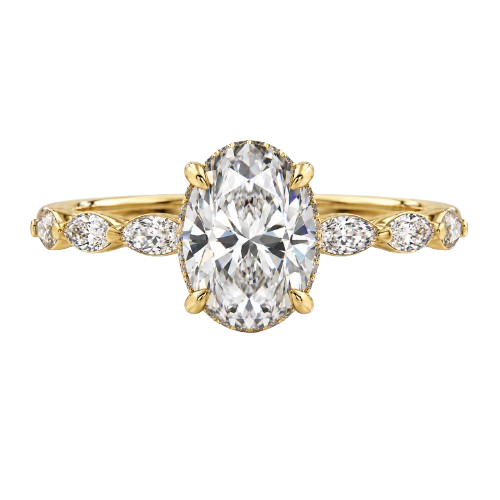
How visible an inclusion looks also depends on the cut. A round brilliant scatters light in many directions, which tends to camouflage small inclusions better than a step cut does. An emerald cut has long, open facets that act almost like a window into the stone, so inclusions that would be hidden in a round diamond can show clearly in an emerald cut of the same clarity grade. This is why the same VS2 stone can look cleaner in one shape than another, and it is worth raising with a designer before a shape and grade are chosen together.
Do lab-grown diamonds have different clarity?
Lab-grown and natural diamonds are graded on the same clarity scale, because they are chemically and optically identical stones, just grown differently. CIZELE sets both from certified inventory on /diamonds/, and the choice between them is covered fully in the guide to lab-grown vs. natural diamonds. Lab-grown diamonds are generally available at higher clarity grades for a lower price than a natural stone of the same grade, which changes the calculation for buyers weighing clarity against budget.
What clarity grade should you actually buy
For most engagement rings, VS2 or SI1 is the practical sweet spot: high enough that inclusions are not visible to the naked eye once set, without paying the premium that VVS or FL grades carry for a difference only a jeweller’s loupe would find. Below SI1, whether an inclusion shows depends heavily on its position and the shape it sits in, so an SI2 stone is worth seeing on video before committing rather than choosing on the grade alone. Budget trade-offs between clarity, carat and other factors are covered in CIZELE’s guide on how much you should actually spend on an engagement ring.
Clarity requirements also shift with carat weight, because a larger stone has a larger surface area for the same inclusion to become visible on, and a larger table facet to view it through. A one-carat stone at SI1 can look cleaner than a two-carat stone at the same grade, simply because the inclusion occupies more visible area on the bigger stone. A grade should be judged against the actual stone being considered rather than treated as a fixed rule that applies at any size.
Clarity vs cut: which matters more
Cut has more effect on how a diamond looks than clarity does, because cut determines how light returns to the eye, while clarity only determines whether marks are visible at all. A well-cut SI1 diamond can look brighter and cleaner than a poorly cut VVS stone, which is why clarity should not be the only number a buyer fixates on. A classic solitaire setting, with nothing else to distract the eye, tends to show off a well-cut stone at any reasonable clarity grade rather than demanding the highest grade available.
Choosing a clarity grade with CIZELE
The right clarity grade depends on the shape, the setting and the budget together, which is easier to work through on a call than from a chart alone. A ring can be built shape by shape on /create/, with the diamond matched afterwards from certified inventory at the clarity grade chosen. To talk through clarity, shape and budget together, message CIZELE on WhatsApp at +20 150 160 5724, or book a private video consultation before any stone is chosen.